

Ephesus & Kusadasi: A Sanctuary of History and the Soul of the Aegean
Whether you arrive here after the vibrant energy of Istanbul or choose this region as your primary destination, the area around Ephesus and Kusadasi stands as a complete world of its own. It is a journey that works perfectly as a standalone escape or as the serene “second act” of a grand Turkish tour.
Landing in Izmir is the threshold to a different pace of discovery. Here, history isn’t just kept in museums; it breathes through the white marble of ancient streets and the salty breeze of the coastline. It is a place designed for those who seek the “luxury of wonder”—a destination where you can touch the stones of empires in the morning and let the Aegean sea wash over your emotions in the afternoon.
Table of Contents
Video. Exploring Ephesus Archaeological Site: A Lifelong Dream Come True with Friends
Visiting Ephesus has been a lifelong dream of mine, and in this video, we finally made it happen—exploring one of the world’s most incredible archaeological wonders with great friends.
From stepping through the grand Celsus Library and the massive Grand Theatre to wandering the bustling Agora and discovering the stunning Terrace Houses, this is a true adventure through time, packed with history, laughs, and unforgettable moments.
Watch the video directly on this page, or click here to view it on YouTube (ideal for mobile users): https://youtu.be/A1R6uohkUMI.


Ephesus Archaeological Site: A Dream Come True With Friends
Walking through the ancient streets of Ephesus felt like stepping straight into a lifelong dream. In this journey, we shared the raw emotions, laughs, and unforgettable moments of exploring this incredible archaeological wonder with friends.
Instead of a dry history lesson, this is a true adventure through time. From marveling at the iconic Celsus Library and the massive Grand Theatre to wandering through the bustling Agora, every corner tells a story. One of the absolute highlights was exploring the Terrace Houses, which instantly reminded us of Herculaneum with their incredible preserved details and intimate glimpse into ancient daily life.
We also gave the immersive 3D experience a try before walking the site—keeping it as a surprise for anyone planning to visit! Watching the 3D projection beforehand actually helped us navigate and recognize exact spots as we walked through the ruins, making the real-life exploration even more magical.
💡 Pro Tip for Your Visit
Before heading to the main archaeological site, we strongly recommend visiting the Ephesus Archaeological Museum first. Getting that foundational context beforehand gives you a deeper appreciation for everything you are about to see and makes the actual walk through the ruins infinitely more rewarding.
Video Chapters
- 0:00 Dreaming of Ephesus & Planning the Trip
- 0:10 Tickets, Best Time to Visit, and Audio Guides
- 0:25 A Kebab Laugh and the Selçuk Archaeological Museum Secret
- 0:46 The Grand Celsus Library
- 1:13 The Commercial Agora and Fun Ancient Jokes
- 1:28 Ephesus Experience Museum
- 1:55 The Harbour Street and Ancient History
- 2:30 Grazia’s Historic Book & The Odeon vs. The Great Theatre
- 2:56 The Great Theatre and the Temple of Artemis Statue
- 3:39 The Terraced Houses: Roman Luxury and Earthquake History
- 4:52 Gabriel Translating the Signs on the Fly
- 5:36 The Exit Mistake, Local Scams, and How We Solved It
- 5:50 Final Thoughts & Wonderful Ephesus
Ephesus in May: The Perfect Spring Weather for Ancient Ruins
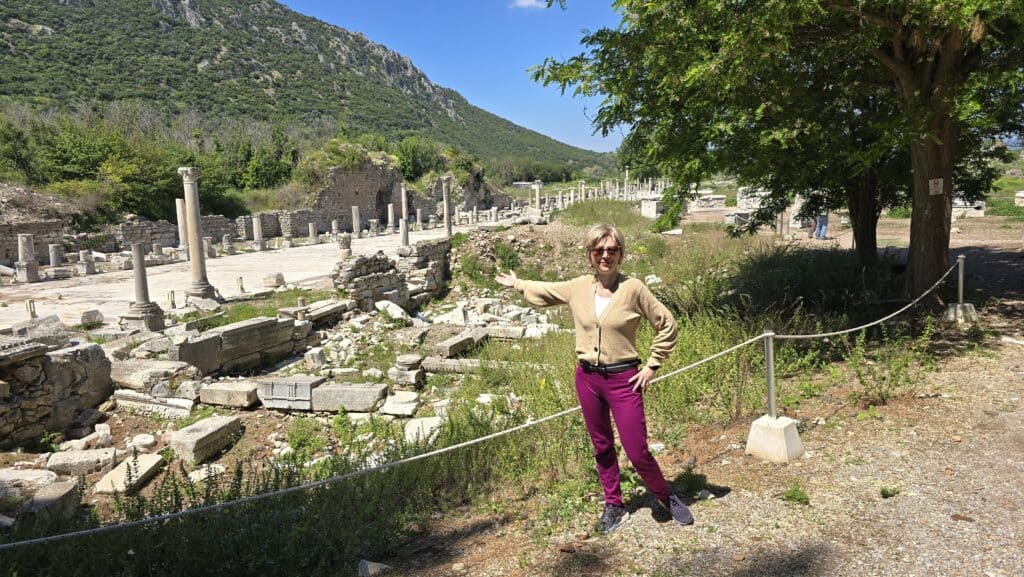
Walking through the ancient streets of Ephesus on May 5, 2026, felt like stepping straight into a lifelong dream. After experiencing an unexpectedly chilly start to the month during our first days exploring Istanbul (which you can check out on our Istanbul Guide), the weather finally broke and turned wonderfully pleasant right as we arrived at the ruins.
If you watch the video, you’ll notice we started the morning in light jackets, but quickly peeled them off to enjoy the day comfortably in light sweaters. Visiting Ephesus in early May is an absolute game-changer: you completely avoid the oppressive, scorching summer heat while missing the bitter cold of winter. It makes walking through the expansive ruins a pure, comfortable joy.
The Eternal Charm of Ephesus: Between Ancient Echoes and the Deep Blue
Ephesus is far more than an archaeological site; it is a sensory immersion into a world that once dictated the rhythm of the Mediterranean. Walking through these ruins, you will encounter the Library of Celsus, a monumental testament to knowledge that still stands with a biblical and architectural majesty that leaves a permanent mark on the heart.
This region offers a unique, dual soul for the modern traveler:
- A Standalone Masterpiece or a Perfect Sequel: This trip is magnificent on its own for a deep dive into history and sea, but it also serves as the ideal relaxation spot to process the deep emotions of Istanbul.
- The Blue Horizon of Kusadasi: By choosing to stay in Camlimani Mevkii, you grant yourself the ultimate gift: the sea. After a morning spent among the whispers of the past and the dust of the ruins, there is no greater luxury than returning to the coast to surrender to the rhythm of the waves.
- History Meets Relaxation: The strategic location of Kusadasi allows you to balance the intensity of exploration with absolute peace. It’s a sanctuary where you can explore the famous ruins and then immediately find yourself staring at the horizon, letting the beauty of the Turkish coast restore your spirit.
Pro Tip: Access and the Art of Flexible Discovery
When you travel to a place like Ephesus, specifically to witness its legendary ruins, it’s natural to feel a pinch of anxiety. We felt it too: that nagging question, “Should I book in advance? What if I get there and I can’t get in?” When a destination is the very reason for your trip, the fear of missing out can be overwhelming.
However, we took a deep breath and decided to trust the rhythm of the place, and we are so glad we did.
The Freedom to Breathe: No Sold-Out Risks. One of the most liberating things about Ephesus is that, unlike many world-famous landmarks, there is no daily limit on visitors. There is no risk of the site being “sold out.” This realization allowed us to let go of the pressure of a rigid schedule. You can comfortably purchase your tickets directly at the entrance upon arrival. Having a pre-booked ticket for a specific day can sometimes feel like a cage; without it, you are the master of your time.
The “Pompeii Effect”: Exploring at Your Own Pace. Much like visiting Pompeii, Ephesus is vast and monumental. It is a city, not just a ruin. By arriving early in the morning—not because we were forced by a ticket time, but because we wanted the soft light and the quiet—we granted ourselves the entire day.
However, having the “whole day available” doesn’t mean you are forced to stay until sunset. If the sun is shining and you’ve soaked in the atmosphere by lunchtime, you have the total flexibility to say: “I’ve seen what I needed for now, let’s head to the sea.” You can surrender to relaxation on the beach in the afternoon and save the museum or the other sites for the next day.
Mastering the Elements and Your Emotions: By keeping our plans open, we gained a strategic advantage over the weather and our own energy levels. Having at least two days in the region allowed us to choose the perfect moment:
- On a bright, sunny day: We headed to the ruins to see the marble glow.
- If we felt like resting: We enjoyed the sea, knowing we could return to history whenever we wanted.
This approach transformed our visit from a “task to complete” into a meaningful, stress-free encounter. It’s the ultimate travel luxury: knowing that the site is waiting for you, and you can enter it exactly when your soul—and the weather—is ready.
Personal Reflections: Why We Chose a Slower Pace
In Turkey, you will find countless bus tours that efficiently take you from one landmark to another. These tours are great, especially if you are traveling with a group of friends and want to share the excitement of seeing many places in a short time. However, my personal travel philosophy usually leads me down a different path. I prefer to focus on fewer areas but give each one the time it truly deserves.
That is why we decided to spend at least two full days in the Ephesus and Kusadasi region instead of a quick day trip. We wanted the flexibility to arrive early, explore without looking at our watches, and perhaps even steal a few hours of relaxation by the sea—even if the early May breeze means the water is more for admiring than swimming. For us, it’s not about how many items we can check off a list; it’s about having the freedom to linger where we feel a connection and ensuring that our journey remains a pleasure, not a race.
Archaeological Wonders and Seaside Serenity: The Ultimate Guide to Ephesus and Kusadasi
Whether you are exploring the Aegean coast as a standalone getaway or as a rejuvenating sequel to the vibrant energy of Istanbul, this region offers a rare harmony between the echoes of the past and the refreshing embrace of the sea. Landing at Izmir airport is your gateway to a land where history isn’t just studied—it is felt.
The Timeless Majesty of Ephesus
The highlight of any visit is, undoubtedly, the Archaeological Site of Ephesus. Walking along its marble-paved streets, you will find yourself standing before the breathtaking Library of Celsus. This isn’t just a ruin; it is a monumental encounter with ancient wisdom that resonates with a profound, almost biblical atmosphere. To truly capture the soul of this civilization, don’t miss the Ephesus Archaeological Museum in Selçuk, where the original statues of Artemis—symbols of eternal fertility—are preserved in all their intricate beauty.
The Luxury of Choice: Marbles in the Morning, Waves in the Afternoon
The secret to experiencing this area without the “traveler’s fatigue” lies in your home base. By staying in the coastal area of Camlimani Mevkii, Kusadasi, you master the art of the balanced journey.
- Morning Exploration: Spend your early hours among the ruins, the Great Theatre, and the Temple of Hadrian while the air is fresh and the light is soft.
- Afternoon Relaxation: Return to the crystal-clear waters of your seaside accommodation. There is a unique emotional shift in touching the warm, ancient stones of Ephesus and, just an hour later, letting the salty Aegean breeze wash it all away.
This is the “luxury of time” in its purest form: the freedom to be a historian by day and a dreamer by the sea by sunset. It is the perfect way to process the deep emotions of Turkey, ensuring you return home not just with photos, but with a restored spirit.
The true beauty of choosing this region lies in the lack of compromise. You don’t have to choose between a cultural pilgrimage and a beach holiday; here, they coexist. This is why staying in Kusadasi, specifically in the Camlimani Mevkii area, is a strategic choice for the soul: it allows you to balance the intense energy of the ruins with the quiet rhythm of the tides.
The Archaeological Heart of the Region: What You Cannot Miss
To truly grasp the magnitude of this land, you need to navigate its history through a few key sites. Each one offers a different emotional layer, from the grandeur of the city to the intimate details of ancient daily life.
1. The Archaeological Site of Ephesus (The Main Gateway). To see the legendary Library of Celsus, you must enter the main Ephesus archaeological site. It is a vast, open-air complex that feels like a city frozen in time. You don’t need a separate ticket for the library; it stands majestically along the Marble Way.
- What to expect: Beyond the library, you will encounter the Great Theatre—an architectural giant—the Temple of Hadrian, and the Odeon. This is where you will truly breathe the atmosphere of an ancient metropolis.
2. The Terrace Houses (Optional but Highly Recommended): Located within the Ephesus site, these require a separate entrance ticket. They were the residences of the Roman elite, adorned with stunning mosaics and frescoes that have been incredibly preserved. If you want to “feel” the heartbeat of how people actually lived their private lives centuries ago, this visit is absolutely worth it.
3. The Ephesus Archaeological Museum (In Selçuk). Many travelers make the mistake of skipping this, but it is fundamental. The museum is not inside the ruins; it is located in the nearby town of Selçuk, just a short drive from Kusadasi.
- Why visit: It houses the most precious original pieces salvaged from the ruins, including the world-famous Statue of Artemis. Seeing the intricate details of these masterpieces up close is an emotional experience that completes the puzzle of what you saw at the excavations.
The Harbor Road: Walking the Path of Ancient Travelers
One of the most moving moments of the visit was standing at the start of the Harbor Road (Arcadian Way). This wide, marble-paved street once connected the bustling Great Theater of Ephesus directly to the sea.
Earlier, at the Ephesus Experience Museum, we watched an immersive 3D projection that simulated the arrival of a ship into the harbor. It made us feel the thrill and danger of the ancient sea voyage, as travelers from across the Mediterranean arrived at this legendary city. Seeing the road in person after that emotional experience was magical. Standing there, I couldn’t help but imagine the countless historical figures and merchants who once walked these very stones. It’s a place where history feels alive, and you can truly visualize the grandeur of Ephesus as a gateway to the world.

Why the Terrace Houses are an Absolute Must-See
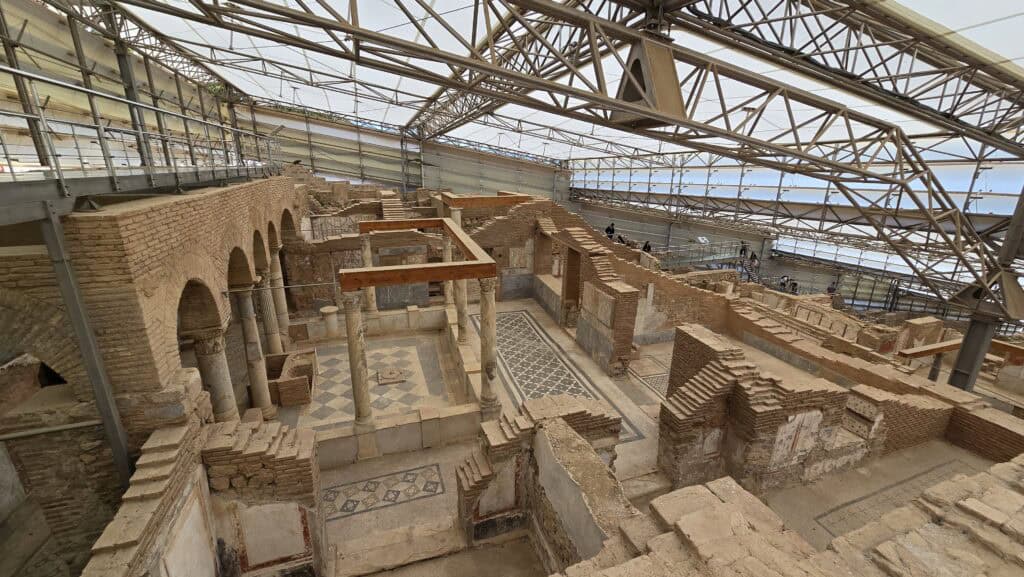
Located about halfway through the archaeological site, right near the Library of Celsus, you’ll notice a large, modern covered structure. This protective roof is essential because these ancient Roman villas are incredibly fragile. To enter, you’ll need to pass through turnstiles using your specific ticket (or your combined pass).
The “Wow” Factor: A Glimpse into Ancient Luxury. Since we visited the Selçuk Museum the day before, we already knew the backstory of these houses. We had read about their evolution and the significant damage they suffered over centuries due to earthquakes. Walking in with that context made the experience even more powerful.
When I stepped inside, I literally said, “Wow!” It truly feels like an “Ephesus version” of Pompeii. The preservation is stunning, especially the intricate mosaics and frescoes. What makes the visit unique is the layout:
- The View from Above: You walk on elevated glass walkways and stairs that hang right over the rooms. This gives you a bird’s-eye view of the ancient layouts, kitchens, and living spaces.
- Protection: The fact that they are covered and climate-controlled makes the visit very comfortable and preserves the vivid colors of the wall paintings.
Traveler’s Tip: The area isn’t huge, so the visit doesn’t take very long. Since you pass the Terrace Houses on your way down toward the Library of Celsus, I highly recommend going in right then to stay ahead of the crowds. However, if you’ve parked your car at the main (upper) entrance, you’ll eventually have to walk back uphill to exit. In that case, you can also save the Terrace Houses for your return trip to the top. It’s a completely different vibe compared to the rest of Ephesus and, in my opinion, the highlight of the entire site. Do not miss them; they are worth every penny!
The “Pompeii Effect”: A Living Ancient Metropolis
While Pompeii offers the breathtaking wonder of a city perfectly preserved by volcanic ash—where everything you see is exactly as it was found—Ephesus provides a different but equally satisfying experience. Here, history hasn’t just been excavated; it has been meticulously brought back to life.
- Beyond Foundations: Unlike other famous ancient sites, such as Sparta, where you often see only the flat foundations of buildings at ground level, the grand structures of Ephesus rise toward the sky.
- The Art of Reconstruction: Using a process called anastylosis, archaeologists have rebuilt monuments like the Library of Celsus and the Temple of Hadrian using their original marble pieces. While this differs from the natural preservation of Pompeii, seeing these structures at their original height gives a profound sense of satisfaction and allows you to visualize the true majesty of the ancient world.
- Walking Through an Actual City: The “Pompeii Effect” at Ephesus lies in the immersion. Because the streets, temples, and squares have been so extensively restored, you aren’t just looking at a pile of stones. You are navigating a vibrant urban space, walking the marble-paved sacred way just as people did centuries ago.
- The Luxury of Exploration: Much like the vastness of Pompeii, Ephesus demands your own rhythm. Since there are no rigid entry times or risks of being “sold out,” you have the freedom to linger. Whether you want to study every detail of the reconstructed facades or simply soak in the atmosphere of a metropolis that refused to stay buried, the choice is entirely yours.
A Moment of Reflection: The Ghost of the Temple of Artemis
Between the grand, restored monuments of Ephesus and the modern daily life of Selçuk, there is a place that tells a story of a different kind. It isn’t a site filled with marble buildings, but a space defined by the power of what is no longer there.
- The Scale of the Past. Today, only a single, lonely column stands in a quiet, grassy field. It takes a true leap of imagination to realize that this was once one of the Seven Wonders of the Ancient World. At its peak, the Temple of Artemis was four times larger than the Parthenon in Athens—a massive marble giant supported by 127 towering pillars.
- The Beauty of Contrasts. If you are interested in this kind of experience, we suggest visiting this site specifically for the contrast. After spending hours among the magnificent reconstructions of Ephesus, coming here offers a profound perspective on the passage of time and the fragility of even the greatest empires. It is a visual shock: seeing how one of the most important structures in human history has been reclaimed by nature. The silence of the field, often interrupted only by the storks nesting atop the last standing pillar, creates a poetic and slightly melancholic atmosphere that you won’t find in the busier archaeological parks.
- A Free and Personal Choice. Since there is almost nothing left to guard, there is no entrance fee and no ticket to buy. It is a completely free and open site. Knowing this beforehand allows you to decide if it’s an experience that fits your rhythm. If you are looking for intact beauty, you might be disappointed; but if you seek a moment of deep reflection on history and the “ghosts” of the past, it is a quick but essential stop. It only takes a few minutes, but the image of that solitary column against the sky is one that stays with you.
Historical Traditions: The Sites of St. John and Mary
Beyond the main archaeological park of Ephesus, there are other sites in the Selçuk area that are part of the local historical identity due to long-standing traditions. You can choose to include them in your itinerary if you are interested in the cultural and traditional heritage of the region.
- St. John’s Basilica and the Ayasuluk Fortress. Located in the center of Selçuk, near the museum, this basilica was built by Emperor Justinian in the 6th century. According to extra-biblical traditions dating back to the early Christian era, this site is considered the burial place of John the Apostle. The ruins allow you to see the grand scale of what was once one of the largest churches in the Byzantine Empire. Adjacent to the basilica, the Ayasuluk Fortress sits atop the hill; it is a strategic point to visit if you want a complete 360-degree view of the entire valley and the surrounding landscape.
- The House of the Virgin Mary (Meryemana). Situated on Mt. Koressos, this small stone house is identified by extra-biblical tradition as the final residence of Mary. It is a quiet site surrounded by nature, managed today as a place of historical and traditional interest.
Ephesus: Travel Notes (May 5, 2026)
The Archaeological Site Experience
Our group of six visited the Ephesus archaeological site, and we absolutely loved it. We arrived at 8:30 AM and finished around 12:30 PM. You should definitely budget at least 4 hours to explore everything at a relaxed pace, listen to your guide, and take plenty of photos.
May is the perfect time to visit: the weather is mild enough for walking comfortably, and while there were several tour buses, it didn’t feel overly crowded. My top tip is to arrive as soon as it opens at 8:00 AM. By arriving at 8:30 AM, we found the site nearly empty, allowing us to stay ahead of the large tour groups. This made the walk very pleasant and got us back to the hotel in time for lunch.
- Audio Guide: We rented one separately. You don’t need one for every person; we used a single audio guide for the whole group by turning up the volume on the smartphone app so everyone could hear the explanations.
- The Terrace Houses: These require a separate ticket, but they are absolutely worth it. These are the best-preserved villas where the wealthy once lived. It feels a bit like Pompeii—an incredible look at ancient daily life that I highly recommend.
- Ephesus Experience Museum: This is located right inside the ruins, near the Great Theater. It’s an immersive 3D projection (no glasses needed) spread across three rooms. They provide headphones with various languages, including English and Italian. Rather than a dry reconstruction, it’s an emotional journey through the city’s glory and eventual decline. Pro tip: The show starts at set times, so if you see a session is about to begin, head in immediately so you don’t have to wait 20 minutes for the next one.
The Winning Strategy: Visit the Museum First
Visiting the Selçuk Archaeological Museum the day before was an excellent decision. It allowed us to see the original statues and reconstructions of the most beautiful monuments before seeing the ruins. The museum also features a video showing the entire city as it once was—essential for creating a mental image of the site, since many parts are currently in ruins. Arriving “prepared” completely changes how you perceive the visit.

Tickets and Accessibility: What You Need to Know
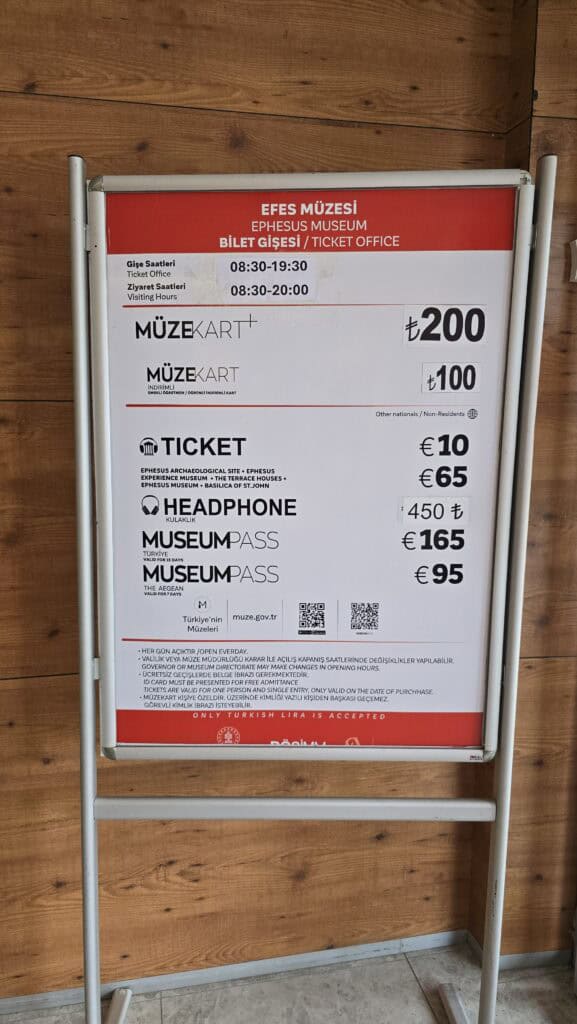
Buying tickets on-site is very straightforward. We purchased a €65 combined ticket at the Selçuk Museum (our first stop), which covers the Ephesus Archaeological Site, Terrace Houses, Experience Museum, Ephesus Museum, and St. John’s Basilica. A crucial detail we learned is that this ticket is valid for 3 days, so you don’t have to rush through everything in a single afternoon.
As you can see from the photo I took at the ticket office, prices are clearly listed. While official signs might mention Turkish Lira, we found that Euros and credit cards were widely accepted without any issues.
A Personal Note on the Disability Card: We also verified the accessibility rules. If you have a Disability Card (we used our Italian one), entry is free at Ephesus and many other sites like the Basilica Cistern or Topkapi Palace in Istanbul. Even if you aren’t sure if an international card will be accepted, my advice is to show it at the window anyway. Policies can change, and it’s always worth asking for a “free entry” or discount. At Ephesus, the Experience Museum is included with this access as it is located inside the site. Typically, the person with the disability enters for free while the companion pays the standard fee.
Logistics and the Parking Odyssey (Heads Up!)
You need to be very careful here. We parked at the main entrance (cost: 4 euros), but the site has an exit on the complete opposite side. If you take the wrong exit, you’ll end up in a massive parking lot for tour buses that is a 21-minute walk from where you left your car.
If you exit at the wrong end, here are your options to get back:
- On foot: About 21 minutes under the sun.
- Horse carriage: They try to charge high prices (they asked for 25 euros) since they have a bit of a monopoly.
- Taxi: The official rate is 15 euros, but after some haggling, we got it down to 10 euros. The taxi took two of us to fetch the car while the other four waited at the “wrong” lot.
Important note for car recovery: The road is one-way, so to pick up the rest of the group, the car had to pass through a toll gate. We had to explain to the staff that we had simply parked at the wrong end to avoid paying extra fees (they wanted 12 euros!). Be very careful with the signs to ensure you exit where you entered, or coordinate the pickup outside the gated areas.
Tickets and Disability Access
Buying tickets on-site is very easy. We purchased a 65-euro “combined ticket” (which includes the Museum, Ephesus ruins, Terrace Houses, Experience Museum, and St. John’s Basilica) during our first stop at the Selçuk Museum. Those in our group who didn’t visit the museum bought their tickets at the Ephesus gate at 8:30 AM with zero wait.
A very important note on the Disability Card: In Ephesus, as well as in Istanbul (at the Basilica Cistern or Topkapi Palace), entry for those with a certified disability is often free. However, be aware that free entry might not cover “exclusive” sections; for example, at Topkapi, the palace is free, but you must pay extra for the Harem. At the Basilica Cistern, it is free during the day but not for night visits.
Regarding the Disability Card, we used an Italian card and it worked perfectly. Even if you assume it might not be recognized in Turkey, my advice is to show your document at the ticket window anyway. Policies change constantly, so always ask if there is a “free entry” or a discount. At Ephesus, the Experience Museum is included in the disability access because it is physically located inside the site. Generally, the disabled person gets in free while the companion pays, but it never hurts to check!
Summary
Ephesus truly leaves a mark on you. It’s a place that captures the soul of a glorious ancient city—provided you arrive prepared and keep a close eye on the parking logistics!
From Ancient Echoes to Coastal Luxury: A Journey for the Soul that Stays in Your Memory Forever
This is not just a trip; it is a collection of unique, authentic memories that bridge the gap between two worlds. After experiencing the vibrant fusion of East and West in Istanbul, your journey reaches a profound depth among the ruins of Ephesus. These are not just stones; they are millenary witnesses to human history and biblical heritage, offering a cultural value that resonates with the spirit.
But the true magic lies in the balance. After the adventure of exploration, you grant yourself the ultimate luxury: the crystal-clear Aegean sea. Unlike the simple charm of the Princes’ Islands, here in Kusadasi—specifically at your seaside resort in Camlimani Mevkii—you find a complete sanctuary. It is the perfect harmony of discovery and comfort, where you can reflect on the wonders you’ve seen while surrendered to the luxury of an all-inclusive retreat. A truly complete journey that satisfies every desire and remains etched in your heart as a one-of-a-kind experience.
The Luxury of Choice: From Private Beach Bliss to the Wild National Park
One of the greatest advantages of staying in a seaside resort in Camlimani Mevkii is the immediate access to comfort. If you are feeling tired after your Istanbul adventures or a long morning among the ruins, you don’t even need to leave your hotel. Most resorts here offer private beaches equipped with sunbeds and umbrellas, allowing you to surrender to total relaxation just a few steps from your room. It is the ultimate convenience: having the Aegean at your feet without any effort.
However, if you have an extra day and still feel the spark of exploration, the coastline hides treasures that deserve to be discovered.
The Dilemma: Pure Rest or New Discoveries? While your hotel provides a perfect sanctuary, the surrounding area is home to the stunning Kusadasi National Park (Dilek Peninsula). This is a place where the forest meets the sea in a wild, untouched embrace.
- Beach Hopping with Ease: If you have the energy to move, you can explore the park’s hidden bays. But for those who want to see it all without the stress of driving or hiking, a Boat Tour is the most evocative choice.
- The Boat Tour Experience: Sailing along the coast of the National Park allows you to reach crystal-clear coves accessible only by water. You can spend the day diving into turquoise depths and breathing the pine-scented air of the peninsula.
- A World of Options: There are many tours available to suit your style. For instance, platforms like GetYourGuide offer various boat excursions—such as this National Park Boat Tour—which serve as a great example of how you can spend a day at sea. Of course, the choice is yours: you can opt for a lively group trip or a more intimate experience.
A Journey Tailored to You
This is what makes this trip so unique: the ability to listen to your own rhythm. You can choose to be a “lazy” dreamer on your hotel’s sunbed or an explorer on a boat deck. Whether you seek the maximum comfort of an all-inclusive resort or the wild beauty of the National Park, this coast ensures that your memories will be as deep and blue as the Aegean itself.
Kuşadası, Turkey: What to See, Do, and Experience by the Aegean Sea near Ephesus
When planning a trip to Western Turkey, thousands of travelers flock to the iconic ruins of Ephesus, the historic Basilica of St. John, and the archaeological wonders of Selçuk. But right next to these ancient landmarks lies a vibrant coastal gem that deserves a spot on your itinerary: Kuşadası. But what to see, do, and Experience in Kuşadası? Go to the following article.
Kuşadası, Turkey: What to See, Do, and Experience by the Aegean Sea near Ephesus
Complete Your Turkish Dream: The Soul of Istanbul Awaits
The beauty of Turkey lies in its infinite layers. If the ancient whispers of Ephesus and the blue horizon of Kusadasi have captured your heart, remember that this is only one side of a magnificent coin. To truly understand the “luxury of wonder” and the deep connection between East and West, you must lose yourself in the vibrant streets of the imperial city.
Whether you started your journey among the ruins or are planning your next stop, don’t miss my dedicated guide to the crossroads of the world.
Ready to explore the City of Two Continents? 👉 How Many Days in Istanbul? A Guide to the Luxury of Time for the Best Experience