They say that Istanbul doesn’t just sit on two continents; it lives in two worlds. It is a city that breathes through its ancient stones and speaks through the rhythmic call to prayer echoing over the Bosphorus. After sorting through the logistics and planning the “how-to” of the journey, I realized that the true magic of Istanbul isn’t found in a brochure—it’s found in the moments where history touches your soul.
In this guide, I want to take you beyond the surface. We will navigate the “Vertical and Horizontal” soul of this metropolis: from the silent, illuminated mysteries of the underground Cisterns to the golden heights of the Galata Tower, and across the shimmering water that unites Europe and Asia.
This isn’t just a list of monuments. It is an invitation to experience the city as I did—balancing the grandeur of the Sultans with the quiet beauty of a colorful street in Kuzguncuk. I’ll share my “Battle-Tested” tips for skipping the digital chaos of ticket bookings, my honest reflections on the physical climb to the city’s best views, and the Personal Map I created to ensure every step you take is intentional, meaningful, and full of wonder.
Get ready to see Istanbul not just with your eyes, but with your heart.
Table of Contents
What to See in Istanbul: The Art of Diversifying Sky, Sea, and Underground
Choosing what to see in Istanbul is not a matter of counting monuments, but of balancing energies. If you spend your days jumping from one museum to another, you will only see the “stone” side of the city, missing its fluid, living soul. To truly experience Istanbul, you must learn to move vertically—from the silent mysteries of the underground to the golden heights of the towers—and horizontally, crossing the sea that unites two worlds. This section is designed to help you select experiences that don’t just fill your camera roll, but leave a lasting impression on your spirit, avoiding the “tourist fatigue” that ruins so many trips.
The Icons of Istanbul: Choosing the Experiences that Truly Move You
In a metropolis as vast as Istanbul, the biggest mistake is trying to see everything. My philosophy is different: we don’t want a checklist; we want experiences that leave a lasting impression on your soul. To truly understand this city, you have to embrace its contradictions—the sacred silence of the domes and the vibrant energy of the water—without ever falling into the monotony of a tourist marathon.
Everything begins in the monumental center of Sultanahmet, just steps from your hotel. Your first encounter with Ottoman spirituality will be the Blue Mosque, with its thousands of blue ceramic tiles, followed by the sheer architectural power of Hagia Sophia, a symbol of the city that has lived through centuries as both church and mosque. But to see the private heart of the Empire, you must enter Topkapi Palace. It is a city within a city, where strolling through courtyards overlooking the sea and exploring the mysterious Harem reveals a sumptuous, private side of Istanbul—a glimpse into the extraordinary daily life of the Sultans.
But the city has a mysterious side that lives underground: the Basilica Cistern. Descending into this silent forest of illuminated columns after a relaxing dinner, perhaps dressed with a touch of elegance for the “Night Shift”, transforms a visit into an atmosphere of pure glamour and mystery.
Once you’ve touched the imperial stone, it’s time to breathe. You cannot say you’ve experienced Istanbul without sailing the Bosphorus. This is the heart of the journey: the feeling of the salt air as you watch the minarets fade behind you. By taking the ferry to the Asian side, you experience a panoramic masterpiece, passing directly under the majestic Bosphorus Bridge. You’ll land in Kuzguncuk, a poetic neighborhood of vibrant, colorful wooden houses where time slows down.
As the sun begins to dip, the Galata Tower offers you the luxury of control. Unlike a boat, you are the master of your time here, watching the skyline turn to gold as the city lights begin to sparkle like diamonds. To conclude, the Evening Dinner Cruise is the ultimate smart move: combining a high-quality meal with the magic of illuminated palaces is the perfect setting for a special anniversary, ensuring you feel like the protagonist of your own Turkish dream.
Navigating Istanbul: My Personal Journey through Tickets and Logistics
Before we dive into the details of each location, I want to share a bit of the “behind the scenes” of my trip. In this guide, I won’t just tell you what to see; I will share my personal experience with the practical side of visiting—how I purchased my tickets and the challenges I encountered along the way.
In a city as dynamic as Istanbul, I often had to make choices: should I book through an agency, wait in line, or navigate the official government portals? My goal in sharing these moments—including the frustrations and the small victories—is to help you prepare and find the most effective way for you to explore.
Every traveler might have a different experience or choose a different path. I’m sharing what worked for me and what I found most useful, hoping it provides a helpful roadmap for your own adventure.
Please keep in mind that since travel policies and websites are constantly evolving, what worked during my journey represents a snapshot in time. I am sharing my logic and my results because they were the most effective for me. I believe that by learning to navigate these details—paying attention to timing, verifying official sources, and managing technical hiccups—we all become more conscious travelers. These are lessons you can carry with you far beyond Istanbul, turning every future journey into a more intentional and rewarding experience.
At a Glance: Practical Pro Tips
| Icon | Why it’s a Must | The “Smart” Tip |
| Blue Mosque | The essence of Ottoman spirituality and blue ceramics. | Free entrance. Closed during 5 daily prayers. Best at 8:30 AM or mid-afternoon. |
| Hagia Sophia | A universal symbol of history and architectural grandeur. | Since 2024, it requires a tourist fee. Respectful dress code is mandatory. |
| Topkapi & Harem | The luxury and secrets of the Ottoman Sultans. | Don’t skip the Harem. It requires a separate ticket but it’s the most fascinating part. |
| Basilica Cistern | A cinematic underground forest with Medusa heads. | Choose the “Night Shift” (after dinner) for an exclusive, crowd-free experience. |
| Kuzguncuk (Asia) | Authentic peace, colorful houses, and “local” soul. | Perfect for a slow lunch by the water. Spartan, real, and poetic. |
| Bosphorus Ferry | The thrill of crossing between two continents. | Use the public ferry to pass under the Bosphorus Bridge—a powerful emotion. |
| Galata Tower | 360° view of the city turning to gold. | Go for sunset. It gives you control over the “Golden Hour” timing. |
| Dinner Cruise | Luxury, tradition, and the city lights from the sea. | Ideal for anniversaries. Includes hotel pick-up—perfect for all ages. |
Blue Mosque
- Architecture: The Blue Mosque, officially known as the Sultanahmet Mosque, is an iconic example of classical Ottoman architecture. Built in the 17th century, it is distinguished by its six minarets and a main dome, surrounded by smaller domes. The interior is decorated with Iznik azulejos, which give it its characteristic blue hue.
- Visiting : The mosque is open to visitors outside of prayer hours. Appropriate clothing (shoulders and knees covered) is required, and shoes must be removed before entering.
An entrance ticket is required for the Blue Mosque. How does the visit work?
Great question, because the situation with the Blue Mosque (Sultan Ahmed) has changed recently and there’s a lot of confusion online. Here are the key points to know to include in your guide:
1. The Ticket: Do you have to pay or is it free?
Unlike Hagia Sophia (which, since the beginning of 2024, has required a tourist fee, about €25), the Blue Mosque is still free. As it is an active mosque, there is no entrance fee. However, precisely because it is a place of worship, there are specific rules to follow.
2. Opening Hours and Closures (Essential!)
You can’t enter whenever you want. Visits are regulated by five daily prayer times :
- The mosque is closed to tourists during prayers (about 90 minutes at a time).
- Friday morning: This is the holiest day. The mosque remains closed to visitors until early afternoon (usually after 2:30 PM).
- Tip: The best time to go is early in the morning (around 8:30/9:00) or between midday and afternoon prayers.
3. How the visit works (Code of Conduct)
Since there is no ticket, the “bargaining currency” is compliance with the rules:
- Dress code: Shoulders and knees must be covered (for both men and women). Women must cover their hair with a headscarf. If you don’t have one, they’ll provide one free of charge at the entrance (sanitized blue cloths).
- Shoes: You must enter without shoes. You will be given a plastic bag to carry them with you during the tour.
- Silence: Inside, keep your voice low and do not take photographs of people praying.
4. The strategy for your itinerary
I would include it in your schedule on May 1st (Day 1) . Since it is very close to Hagia Sophia and the Basilica Cistern, you can take a tour of the square.
- Tip: If you see a long line at the Blue Mosque, go for another visit and come back an hour later. Since there’s no fixed time tied to a ticket, you can be flexible.
Hagia Sophia vs. Blue Mosque: Which One Should You Choose?
Question: What exactly is Hagia Sophia? Is it still a mosque? And if I’m short on time and can only visit one, which is better: the Blue Mosque or Hagia Sophia? What’s the real difference?
Answer: This is the most common dilemma for travelers, as these two architectural giants face each other across the same square. The short answer is: they are profoundly different, both in their history and their visual impact.
Here is a clear breakdown to help you decide—or to explain why visiting both is worth it:
1. Hagia Sophia (Ayasofya): A Walk Through World History
What it is: Built as a Christian cathedral in 537 AD (it was the largest church in Christendom for a thousand years), it was converted into a mosque in 1453, then a museum in 1934, and reverted back to a mosque in 2020.
Why choose it: Entering here is like stepping into the history of the world. You will see golden Christian mosaics standing alongside massive discs of Islamic calligraphy. The architecture itself is an engineering miracle from nearly 1,500 years ago.
The “Tourist Note”: As of 2024, foreign visitors pay a €25 entry fee and access only the upper gallery. While you no longer walk on the main prayer carpet, the view from above is absolutely breathtaking and offers a unique perspective on the structure.
2. The Blue Mosque (Sultan Ahmed): Elegance and Harmony
What it is: Built in the early 1600s directly facing Hagia Sophia to prove that Ottoman architects could surpass the grandeur of Byzantine builders. It has always been a place of worship.
Why choose it: For pure aesthetics. It is famous for its 20,000 blue Iznik ceramic tiles and its six spectacular minarets. Inside, the atmosphere is brighter, more colorful, and more harmonious compared to the somber majesty of Hagia Sophia.
The “Tourist Note”: Entry is free of charge (donations are welcome).
The Verdict: Which one should you pick if time is tight?
If you absolutely have to choose just one, here is my advice based on your travel style:
Choose Hagia Sophia if you are a lover of history and contrasts. It is a place like no other on Earth, where East and West have literally overlapped for centuries. It is moody, imposing, and deeply mystical.
Choose the Blue Mosque if you are looking for classic architectural beauty and want to experience a traditional imperial mosque without the €25 price tag. It is airy, bright, and iconic.
My recommendation for your itinerary: Since they are only 200 meters apart, the ideal plan is to admire both from the outside to appreciate the architectural contrast. However, if you only want to go inside one, I suggest Hagia Sophia. That specific mix of Christian mosaics and Islamic symbols is the very essence of Istanbul—you won’t find it anywhere else in the world.
Is it better to visit the Blue Mosque or the Hagia Sophia in Istanbul?
Don’t waste time wondering which is better: Hagia Sophia is History, the Blue Mosque is Beauty. If you’re on a budget and want to see the soul of Istanbul, enter Hagia Sophia; if you want a free and iconic experience, the Blue Mosque will leave you speechless.
Saint Sophia
- History : Hagia Sophia, originally a Christian basilica, was transformed into a mosque after the Ottoman conquest of Constantinople. Today it is a museum, preserving elements of both cultures. The imposing dome and Byzantine mosaics are testament to its long and troubled history.
- Importance : Hagia Sophia is considered one of the symbols of Istanbul and one of the city’s main tourist attractions.
Galata: One of Istanbul’s Most Iconic and Charming Districts
Galata is undoubtedly one of the most beautiful and atmospheric neighborhoods in Istanbul. With its narrow cobblestone streets, artisan shops, and the majestic Galata Tower watching over the city, it feels like stepping back in time. It is a place where history and modern creativity blend perfectly, offering some of the most characteristic views you will find in Turkey.
Understanding Accessibility: The Stairs of Galata
However, the very charm that makes Galata unique also presents a small challenge: its terrain. The district is built on a steep hill. When you arrive at the Karaköy tram station, you will encounter several flights of stairs and steep alleys (like the ones shown in the photo) to reach the heart of the district and the Tower.
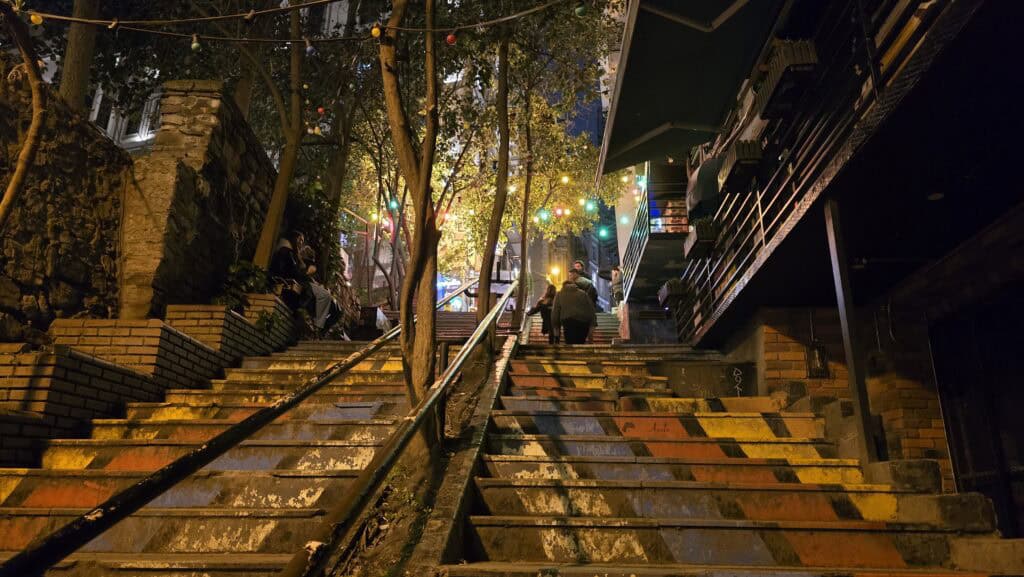
For those with mobility concerns, it’s important to know that while you can try taking a taxi to get closer to the Tower, Istanbul’s legendary traffic can be unpredictable. Sometimes, taxi drivers may still drop you off at the foot of the hill if the streets are too congested. If you prefer to walk, take your time and enjoy the scenery, but be prepared for a bit of a climb!
Exploring Galata: A Personal Note on the Climb
“I wanted to share this specific photo of the stairs because, during my time in Istanbul, I personally felt every single step. Dealing with some temporary shortness of breath in those few days, the climb to the top of Galata was a bit of a challenge for me.
However, travel is also about the people you’re with. Gabriel was right there to give me a hand and encourage me all the way to the top. It’s a reminder that while these historic streets are breathtakingly beautiful, they do require a bit of effort—but with a steady pace and a helping hand, the view from the top is worth every heartbeat.” Ila
Getting to the Galata District
Exploring the Galata district is incredibly easy from Sultanahmet. Since our hotel was located near the Blue Mosque, we found the tram to be the most convenient way to get there.
- The Route: Take the tram (Line T1) for just four stops.
- The Stop: Get off at Karaköy. This station drops you off right at the base of the Galata neighborhood.
- The Walk: Once you arrive in Karaköy, you’ll find yourself at the foot of the hill. Just a short walk ahead, you’ll see the stairs to climb up toward the Galata Tower. It is a bit of a steep walk, but absolutely worth it!
Pro Tip: The stop right before Karaköy is Eminönü (on the same tram line). This is the main hub where you catch the ferries to the Asian side. Because everything is on the same line, Sultanahmet is perfectly connected to both the ferries and the historic charm of Galata. It makes navigating the city’s main highlights very simple!
Galata Tower: The Most Beautiful View of the City
The Galata Tower (Galata Kulesi) is not just a landmark; it is a silent witness to centuries of history. Built in 1348 by the Genoese as the “Tower of Christ” (Christea Turris), it was the highest point of the city walls of the Genoese colony in Galata. Over the centuries, it served as a watchtower for spotting fires, a prison, and even an astronomical observatory.
One of the most fascinating legends tells of Hezarfen Ahmed Çelebi, who in the 17th century reportedly donned artificial wings and leaped from the top of the tower, flying across the Bosphorus to the Asian side—making him one of the world’s first aviators.
Essential Visiting Tips:
- Hours: The tower is open late (usually until 10:00 PM). Visiting after 8:00 PM is often less crowded.
- Cost: Admission is around €30. While expensive, the 360-degree view and the internal museum justify the cost for those seeking unforgettable photos.
- Post-visit: The surrounding neighborhood is one of the liveliest for modern cuisine and nightlife.
Galata Tower: The Ultimate “Inside & Out” Experience
To truly capture the essence of Galata, you shouldn’t just choose between visiting the interior or admiring it from afar. The smartest strategy—and the most rewarding for your photo album—is to do both.
Step 1: The View from Within (History & Panorama)
Climbing to the top (61 meters) is the only way to get a true bird’s-eye view of the Golden Horn and the Bosphorus. Inside, the modern museum adds cultural depth, explaining the tower’s origins and the legendary flight of Hezarfen.
Step 2: The View from Outside (Tea, Dinner, and Atmosphere)
After descending, the experience is only halfway complete. You need to head to a nearby rooftop to embrace the “luxury of time”:
- The Authentic Turkish Tea Break: Visit Galata Konak Café for a traditional tea with the Tower standing tall right in front of you.
- A Typical Turkish Dinner: Book a table at Barnathan Istanbul or Anemon Galata. These terraces place you at eye-level with the Tower, allowing you to enjoy authentic cuisine with the illuminated landmark as your dinner companion.
The Ultimate Galata Loop: A Perfect Afternoon Itinerary
Designed for groups, this plan ensures everyone enjoys the neighborhood without stress:
- The Warm-Up: Stop at Galata Konak Café after the ferry ride to rest and grab your first iconic “tea with a view” photo.
- The Ascent: Head to the Tower. If someone in your group prefers to skip the climb, they can continue relaxing at the café or stroll through the charming side streets filled with boutiques and galleries.
- The Grand Finale: Reunite the whole group for dinner at a nearby rooftop restaurant. Now that you’ve seen the city from the tower, you can relax and look at the tower itself as it lights up for the night.
The Verdict: Visiting the inside gives you the scale; staying outside gives you the emotion. Combining both is the only way to truly experience Galata.
Galata Tower Strategy: Maximum Flexibility
For the Galata Tower, I’ve decided to avoid third-party agencies and stick exclusively to the official government portal: muze.gov.tr.
The most important detail I found is the flexibility of the official e-ticket: at a fixed price of 30 Euro, the ticket remains valid for 90 days from the date of purchase.
This is a game-changer for our planning. There is no need to commit to a specific date or time slot. We have a 3-month window to use it, allowing us to choose the perfect moment to climb—perhaps when the weather is clearest or during the golden hour for the best photos. While the tower has physical capacity limits due to its historic structure, having an “open ticket” means we aren’t pressured by a ticking clock. Unlike the rigid booking systems in Seville, Istanbul (via the official site) offers the breathing room every traveler dreams of. Buy it once, use it whenever you’re ready!
Booking Your Visit: My Experience with the Official Portal
Based on my experience, if you want to organize your evening at the Galata Tower, using the official website (muze.gov.tr) is a practical option. The system works quite well and allows you to manage the purchase independently.
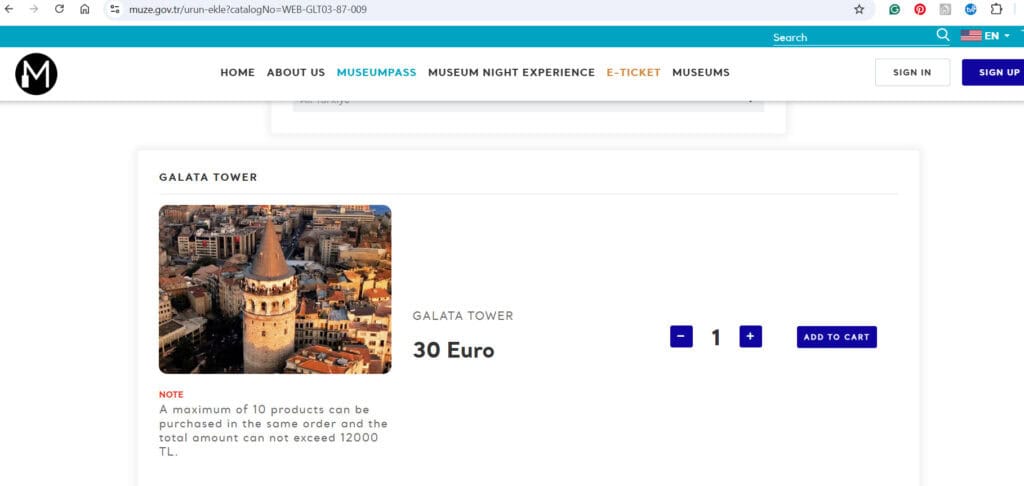
Here is how the process works:
- Ticket Selection: You can find the Galata Tower under the museum list. The current entry is 30 Euro. You simply select the number of tickets and add them to your basket.
- Validity: A useful detail is that these e-tickets are valid for 90 days from the date of purchase, providing some flexibility if you need to change the day of your visit.
- Required Information: You will need to provide your name and a valid email address. This is where the digital tickets will be sent once the process is complete.
- Final Summary: The system shows a summary of the order with the total amount calculated in Turkish Lira (TL) according to the daily exchange rate.
- Receiving the Ticket: Once the transaction is finalized, the ticket usually appears directly on the confirmation screen for immediate download, which is convenient if you are already on the move. A copy is also sent to your email.
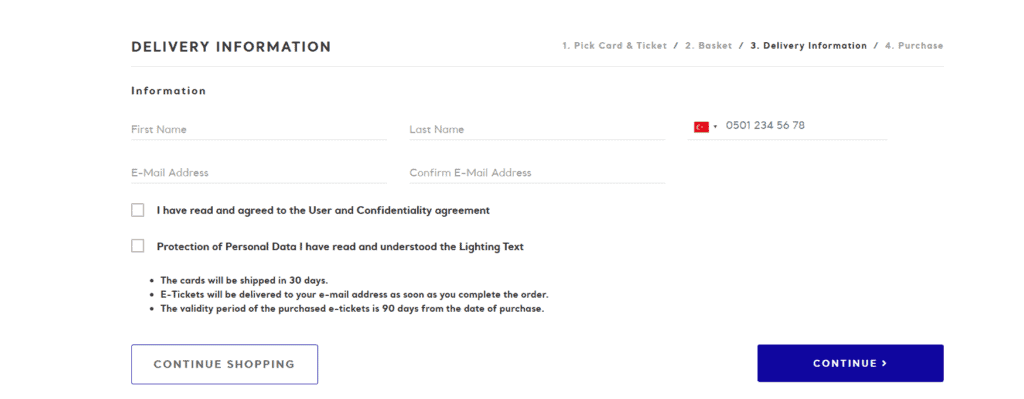
Terms and Support:
- Right of Withdrawal: According to the terms provided by SICPA Türkiye, there is a 14-day window to request a return, provided the notice is received within that period.
- Customer Service: For any technical issues or questions regarding the tickets, you can reach out to their support at yardim@muze.gov.tr or via telephone at 444 6893.
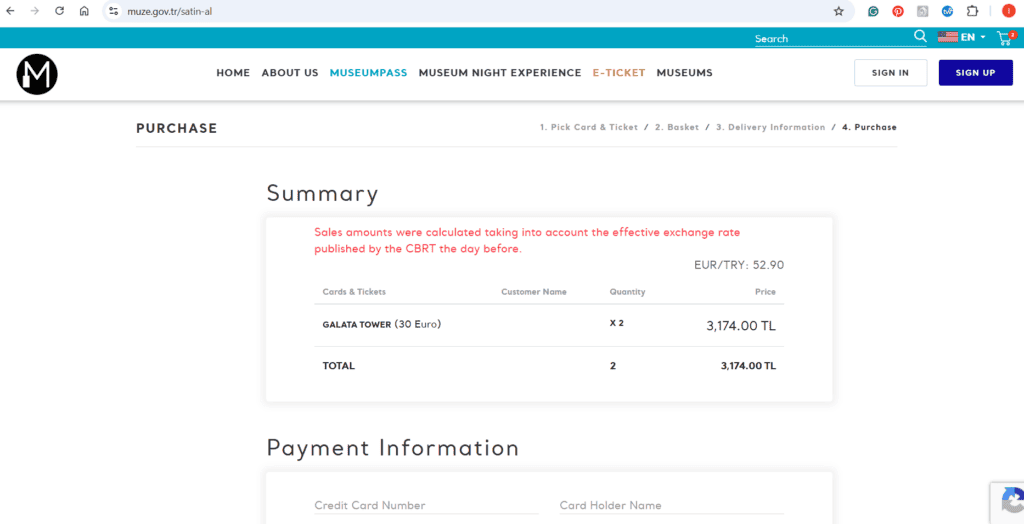
Having the digital ticket on your phone can save time at the entrance, letting you focus on the atmosphere of the district as the evening begins.
Important: Timing and Ticket Validity
One thing I noticed while planning my visit is that the Galata Tower ticket policy differs from other major sites in the city, like the Basilica Cistern.
- No “Night-Only” Restriction: Unlike some other attractions where daytime tickets are explicitly not valid for evening events or night entries, the ticket I purchased for the Galata Tower appears to be valid for a single entry at any time during the tower’s official opening hours.
- Flexibility: This allows you more freedom to decide whether you want to see the city under the midday sun or during the “Golden Hour” as the city lights begin to sparkle.
- Stay Updated: Since policies and opening hours in Istanbul can change quickly, I always recommend checking for any recent notes or updates on the official site before you head out. I will make sure to post any significant changes here if they arise.
Official Ticket Terms: What to Expect
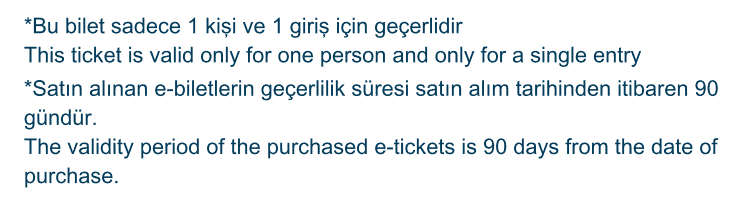
When you receive your official e-ticket, it includes a set of specific notes that clarify the usage rules. Since these details are printed directly on the document (right next to your QR code and personal data), they represent the most direct information available to the visitor.
Based on the notes provided on the ticket:
- Single Entry: The ticket is valid for one person and allows for a single entry to the monument.
- Extended Validity: A key advantage is the 90-day validity period from the date of purchase. This suggests that the ticket is not tied to a specific day or hour, offering great flexibility for your travel plans.
- Standard Access: The document does not specify any hourly restrictions or separate “evening” categories. Typically, if such limitations existed, they would be clearly stated on the ticket to ensure proper management at the gate.
A Practical Perspective
Providing these details is about sharing all the available information to help you plan your visit effectively. While it’s always common sense to be aware that site management can update local policies, the information printed on the ticket is quite clear. This documentation allows you to organize your experience—whether you prefer the bright morning light or the sophisticated atmosphere of Istanbul at night—with a solid understanding of the official terms.
My Online Booking Experience: A Practical Comparison
After attempting to book several attractions in Istanbul directly through official websites, I have to admit that the experience varies significantly. While for some landmarks it felt like a “mission impossible” to complete a transaction, the Galata Tower portal was ultimately successful.
It is worth noting, however, that the process required some patience. My first attempt with my credit card failed without a clear reason—a common occurrence with international booking systems. I had to try a second time, and luckily, the transaction went through smoothly on the next attempt.
The Verdict: Despite the minor technical hiccup at the start, it is indeed possible to purchase your ticket directly from the official site and receive it immediately.
🏛️ Topkapi Palace: The Ultimate Guide to the “Ghost Ticket” Mystery
The Topkapi Palace is the crown jewel of the Ottoman Empire, but getting a ticket can feel like an imperial riddle. If you’ve tried to book online and felt frustrated, you aren’t alone. Here is the unfiltered truth about the booking chaos and how to navigate it like a pro.
👻 The “Ghost” Monument: Why Official Sites Fail
You go to the official government portals (muze.gov.tr or millisaraylar.gov.tr) and the Palace simply isn’t there. It doesn’t show up in the search, or the calendar is completely greyed out, even for dates just days away.
- The Reality: Due to bureaucratic shifts or unannounced holiday schedules (like the tricky May 1st weekend), the official sites often “hide” the monument. This digital blackout is exactly what pushes desperate travelers into the arms of high-priced agencies.
Fortunately, you can beat the system by checking the official holiday and opening schedule at this link. A quick double-check just a few days before your visit will ensure your itinerary is bulletproof: https://www.millisaraylar.gov.tr/Lokasyon/2/Topkapi-Sarayi.
🎭 The Agency Trap: Paying €60 for a “Maybe”
When the official site fails, you might turn to an agency. Be careful. As we experienced, these platforms often provide a “booking confirmation” that is dangerously vague.
- Missing Details: You might receive a confirmation email that doesn’t even clearly state your booking date.
- The Vague “Host” System: Instead of a real ticket, they often give you a meeting point and a “host.” If the Palace is closed or the situation is tense, these agencies become evasive, leaving you in limbo until the very last minute.
⏳ The “Time-Slot” Illusion: Scarcity vs. Flexibility
Agencies force you to select a specific entry time (e.g., 10:30 AM) to make the experience feel exclusive and limited.
- The Truth: In reality, Topkapi Palace tickets are generally flexible for the day. The “fixed time” is often just for the agency’s convenience to group tourists together.
- Don’t be fooled: They create a false sense of “sold out” pressure to justify their €59 price tag (nearly double the official rate).
🇪🇸 The “Seville Trauma”: When Plans Fall Apart
Many travelers (ourselves included!) are “scarred” by experiences in cities like Seville. For our visit to the Real Alcázar, we did everything by the book: we reserved through an agency months in advance. Then, the nightmare happened: the agency cancelled our booking at the very last minute.
When we rushed to the palace gates, it was too late. The daily quota was hit, tickets were sold out, and there was no way in. This is because Seville has a strict physical capacity limit to protect its delicate Moorish architecture.
The Silver Lining: While we missed the Alcázar, we didn’t let it ruin our mood. We pivoted and visited the Seville Cathedral instead, and honestly? We loved it. It was so breathtaking that we didn’t even feel the “loss” of the palace. Of course, I will return to Seville specifically to see the Alcázar one day, but this taught us a vital lesson: Travel requires flexibility, but also being well-informed to avoid surprises.
🇹🇷 Istanbul Reality: Space vs. Scarcity
Because of that Seville experience, we were worried when our Istanbul agency started being vague about our May 1st booking. But here is the good news: Topkapi Palace is NOT the Alcázar.
- The Scale: Topkapi is a massive 700,000-square-meter complex. It doesn’t “sell out” in the literal, restrictive way Spanish palaces do.
- No Need for Panic: While Seville is a bottleneck, Istanbul’s “sold out” status online is usually just a website glitch or a bureaucratic delay, not a lack of physical space. You don’t need to despair; there is almost always a way in.
🛠️ The Tripilare Hack: Trust the On-Site Kiosks
Since the websites are buggy and the agencies are unreliable, here is our battle-tested advice: Use the Kiosks at the gate.
- The Move: If you are staying in Sultanahmet (like we did at The Byzantium), skip the online headache. Walk to the Palace entrance the afternoon before.
- Why it works: The automated machines at the gate are official, accept international cards, and show the real availability and holiday hours. No middleman, no hidden fees, and no “ghost” confirmations.
💎 Pro Tip: The “Palace + Harem” Combo
Regardless of how you buy your ticket, never skip the Harem. It is the most ornate and historically significant part of the residence. Make sure your ticket (whether from a Kiosk or a 15-day-advance official window) specifically includes the Harem access.
Strategic Tip: Why Topkapı Palace Belongs to Day 1
There is a common mistake in many travel guides: suggesting the Topkapi Palace as a “filler” for the last day. My advice is exactly the opposite: visit it on your first full morning. Topkapi isn’t just a museum; it’s an immense city within a city that demands your full energy and a fresh mind.
Start Fresh, Finish Free By heading to the Palace first thing in the morning on Day 1, you beat the largest crowds and, most importantly, you aren’t looking at your watch. The beauty of Topkapi is that you can get lost in its stories for three, four, or even five hours—some people move fast, others want to linger in the Harem or admire the views of the Bosphorus from the kiosks.
Doing this on the first day means you can decide your own pace. If you’re enchanted by the tiles and stay longer, it doesn’t matter: you don’t have a flight to catch. Once you’ve absorbed all that imperial glory, you can simply walk out and spend your afternoon in the Grand Bazaar or the Spice Bazaar. These spots don’t have a “closing time” that creates pressure; you can wander through the stalls, sip tea with merchants, and soak up the energy of the city without any logistical stress.
Why Day 1 is the Winning Choice:
- Maximum Energy: You are fresh from your first night’s sleep in Istanbul. Navigating the vast courtyards and the Harem requires focus and stamina that you simply won’t have on Day 3.
- No “Flight Anxiety”: Saving a major site for the day of departure is a logistical trap. If there’s a long queue or you want to stay longer, you’ll be stressed about getting back to the hotel for your bags. On Day 1, your time is your own.
- The “Bazaar” Buffer: The Bazaars are the perfect follow-up. Since they don’t require a fixed visiting duration like a palace, they act as a flexible buffer for the rest of your afternoon.
The Strategy: Be there at the opening. Book your tickets in advance to skip the first line, head straight for the Harem, and let the history of the Sultans sink in while you’re at your best. This way, your journey starts with a “grand finale” level of wonder, leaving you relaxed for the rest of your stay.
Why Booking in Advance Doesn’t Always Buy Peace of Mind
It’s a common traveler’s dilemma: you want to be organized, so you book months ahead through an agency to avoid anxiety (ex. topkapipalacetickets.com). But as we learned, paying in advance is not a 100% guarantee.
Even after providing our credit card details and completing the payment for Topkapi, the agency told us that we had to contact them 48 hours before the tour to confirm if the booking was actually valid. It’s a paradox—you pay a premium price (often double the official rate) only to end up doing the coordination work yourself.
The Tripilare Take: Don’t let agencies hold your money hostage. In a system like Turkey’s, which can be flexible with schedules and opening hours, committing your funds too early to an unresponsive middleman often adds more stress than it removes.
The “Sultanahmet Safety Net”: Your Essential Plan B
Travel requires a balance of planning and flexibility. We recommend scheduling Topkapi for your first available morning in Istanbul. This gives you a “backup morning” if something unexpected happens.
However, if you arrive at the gates and find the Palace closed or the line unmanageable, don’t let it ruin your trip! Pivot immediately to our Sultanahmet Plan B, all within a 5-minute walk:
- The Great Palace Mosaics Museum: Discover stunning Roman-era floor mosaics hidden just behind the Blue Mosque.
- Arasta Bazaar: A beautiful, open-air alternative to the Grand Bazaar. It’s quieter, more scenic, and perfect for a morning stroll.
- The Museum of Turkish and Islamic Arts: Housed in the palace of Ibrahim Pasha, it offers incredible artifacts and a unique view of the Hippodrome.
- The Hippodrome Monuments: No ticket or queue required. Walk through history by visiting the Egyptian Obelisk and the Serpentine Column.
💎 Final Takeaway: The Art of Traveling with a “Plan B”
Being an informed traveler isn’t about controlling every second; it’s about knowing when to hold on and when to let go. Our experience in Seville was a turning point: even though the Alcázar was out of reach due to a last-minute cancellation, the Seville Cathedral was so magnificent and soul-stirring that we didn’t feel we had lost anything. We simply decided we would return to see the palace another time. That day taught us that flexibility is the ultimate travel luxury.
The same philosophy applies to Istanbul. While places like Seville have rigid, unbreakable limits, Istanbul offers more breathing room. Don’t let agencies pressure you into overpaying for a “guarantee” that often doesn’t exist. If you find the gates of Topkapi closed or the digital maze too frustrating, don’t despair.
Stay conscious, stay positive, and keep your Sultanahmet Plan B ready. Whether you are gazing at the breathtaking mosaics of the Great Palace or marveling at the Sultan’s courtyards, remember: the journey is about the wonders you do see, not the ones you missed. Trust the on-site kiosks, embrace the unexpected, and above all—enjoy the journey!
Official Source for Opening Hours
To avoid any confusion or booking errors, I highly recommend checking the official website of the National Palaces Directorate:
🔗 millisaraylar.gov.tr/Lokasyon/2/Topkapi-Palace
Pro Tip: Always verify the opening hours and special closures (like May 1st or religious holidays) just a few days before your visit. In Istanbul, official confirmations for special openings are often released at the last minute, and relying on this site is the only way to get 100% accurate information directly from the source.
Basilica Cistern Tickets & Visiting Guide: How to Avoid Online Scams.
- Engineering feat : The Basilica Cistern is one of the largest and best-preserved underground cisterns in Istanbul. It was built in the 6th century by order of Emperor Justinian and served to supply water to the Great Palace of Constantinople.
- Atmosphere : The cistern is an evocative place, with its marble columns and the water reflecting the lights.
The Basilica Cistern ( Yerebatan Sarnıcı ) is perhaps the most evocative and cinematic site in all of Istanbul. Travelers are often more impressed by this underground world than by the mosques above ground.
Here’s everything you need to know to fit it into your schedule:
What to expect: A magnetic atmosphere
Imagine descending below street level and finding yourself in a “sunken cathedral.” It’s a huge 6th-century water reservoir supported by 336 marble columns.
- The Medusa Heads: At the bottom of the cistern, you’ll find two columns resting on bases shaped like Medusa’s heads (one upside down, the other sideways). They are mysterious and beautiful.
- Lighting: Recently restored, the Cisterna features a dynamic lighting system that changes color (from fiery red to emerald green), creating incredible reflections on the water.
- The artwork: Contemporary art installations floating on the water are often found along the route, making the experience even more surreal.
Visiting the Basilica Cistern during the ‘Night Shift’ isn't just a tour; it’s a sensory surrender. Stepping into this subterranean world after dinner feels like entering a living dream—where golden reflections dance on the water and the silence speaks of centuries past.
No crowds, no rush. Just the luxury of time to let the mystery of Medusa and the rhythm of the dripping water wash over you. This is the Istanbul I fell in love with: the one that asks you to stop, breathe, and simply marvel. 🏛️💧🌙
Prices and Tickets (Updated 2026)
- Cost: The ticket for foreign tourists costs around 30 euros, depending on the exchange rate and recent increases.
- Evening admission: Please note that after 7pm the price often increases because the “Night Shift” rate applies for night visits (very suggestive but more expensive).
Basilica Cistern: Don’t Let the Web Fool You. A Guide to an Authentic Experience
For many international travelers, visiting Istanbul is a once-in-a-lifetime journey to the crossroads of civilizations. However, the anxiety of “doing it right” often leads into two distinct traps. First, online resellers dominate search results, charging up to €70 for “skip-the-line” packages with guides you might not want. Second, some budget blogs advise visiting during the day simply because it’s cheaper. This is a mistake that sacrifices the very soul of the monument for a few euros. 🏛️
Important Note: Prices in Turkey are subject to frequent changes due to inflation and exchange rate fluctuations. Always verify the current rates at the official ticket window upon arrival. ⚠️
| Currency | Official Night Shift Price (Approx.) | Reseller/Trap Price (Approx.) |
| Euro (€) | €36 | €65 – €70 |
| British Pound (£) | £30 | £55 – £60 |
| US Dollar ($) | $39 | $70 – $75 |
Basilica Cistern vs. Serefiye Cistern: Which one should you choose?
To understand the grandeur of the Basilica Cistern, you must look at the scale. While the nearby Serefiye Cistern is a beautiful boutique space with 32 columns, the Basilica Cistern is an underground ocean supported by 336 massive columns.
The “visual shock” when you descend the stairs is incomparable:
- Perspective: The sheer number of columns creates a “stone forest” effect where the view fades into an infinite, misty horizon. 🌫️
- Atmosphere: Unlike the Serefiye, which uses modern 3D light shows (reminiscent of contemporary art installations), the Basilica uses subtle, non-invasive lighting. The lights aren’t the protagonists; they are there to whisper the story of the stones.
| Feature | Serefiye Cistern | Basilica Cistern |
| Columns | 32 🏛️ | 336 🏛️ |
| Size | ~1,100 m² 📐 | ~9,800 m² 📐 |
| Vibe | Modern/Digital 💻 | Eternal/Mystical ✨ |
Basilica Cistern Night Shift: Is the Evening Visit Worth the Price?
Searching for tickets on official sites like Passo.com.tr can be frustrating, as evening slots often don’t appear until the last minute. Don’t panic and don’t overpay resellers. If you stay in Sultanahmet, the solution is simple: Go to the physical ticket window on the day of your visit.
The wait for the Night Shift is usually only 15-20 minutes for security 🛡️. You will pay the official price (around €36) and gain an experience that is 100% better than the daytime version:
- Slower Pace: No crowds rushing you.
- Sensory Journey: Ambient music and shadows that make the Medusa heads look even more enigmatic. 🐍
The Beauty of “Plan B” 🌙
Real luxury in travel is flexibility. Don’t bind yourself to a rigid schedule. If you are too tired on your first night, just walk by on your second or third evening after a slow dinner. The Cistern is a gift you give to yourself when the moment feels right.
In the end, we travel to build indelible memories. Don’t let a “budget tip” or an overpriced reseller ruin the chance to stand in silence amidst 1,500 years of history. 💍
The Basilica Cistern: Is it better to visit during the day or at night?
Question: I’ve heard the Basilica Cistern is a must-see, but when is the best time to go? Does the atmosphere change at night, and is it worth the different ticket price?
Answer: This is an excellent question because the vibe of this “Sunken Palace” shifts dramatically depending on the clock. If I had to give you a recommendation based purely on emotion, I would say the evening is unbeatable, but there is a logistical “but” to consider.
Here is how the two experiences compare:
The Evening Version (Night Shift)
After 7:00 PM, the Cistern reveals its most mysterious face.
Why it’s better: The lighting is more intense and carefully designed. The darkness between the columns is deeper, and the LED light displays (shifting from ruby red to gold and turquoise) create a magnetic contrast with the water.
The Atmosphere: It is much quieter. The large tour groups and school trips are gone, and it truly feels like stepping into a secret, ancient temple.
The Downside: The ticket is more expensive (Night Shift tariff), and you need to ensure you still have the energy after a long day of exploring Istanbul.
The Daytime Version
Why choose it: It’s easier to fit into your “classic loop” between Hagia Sophia and the Blue Mosque. It also costs slightly less than the nighttime rate.
The Downside: It can get very crowded. The chatter of crowds and camera flashes can occasionally break the magic and the sense of mystery that defines this place.
My Expert Verdict for Your Itinerary
Since your first day in Istanbul is usually very packed, I recommend visiting in the late afternoon (around 5:30 PM or 6:00 PM).
Here is why this is the strategic “sweet spot”:
Best of Both Worlds: The external light starts to fade, and the crowds begin to thin out, but you still pay the lower daytime fare.
The Surprise Effect: Coming out from the underground silence to see the mosques brilliantly illuminated for the evening is a breathtaking contrast.
Time Optimization: It’s the perfect way to wrap up your monumental sightseeing before heading to dinner or your Bosphorus cruise.
A Little Secret: For a true “Wow” moment, once you reach the famous Medusa Heads at the far end, stop for a moment in silence. Even during the day, if you manage to tune out the surrounding noise, the sense of ancient peace is incredible.
Freedom and Budget: A Democratic Approach
One of the main advantages of this sequence is the respect for the needs of all participants:
- Cost-conscious choice: The evening tour is more expensive than the daytime one (Night Shift rate). By making it the last stop after dinner, you give everyone the freedom to decide based on their own budget.
- Complete independence: Those who wish to experience the magical “sunken cathedral” can do so with complete peace of mind. Those who prefer to save money, or are simply tired after a day on the islands, can easily return to the hotel, just a two-minute walk away.
- No unnecessary waiting: Thanks to the hotel’s strategic location, the group doesn’t have to stay together. Those entering the Cistern and those returning to their rooms split up seamlessly, with no one having to wait in the street for the others.
My advice: On a group trip, time management and individual freedom are the key to success. Offering the Cistern as an optional “grand finale” after a delicious dinner allows everyone to experience the Istanbul they prefer, concluding the evening with an unforgettable touch of class.
A Touch of Class: Why Dress Up for the Cisterna Evening
There’s a reason I recommend stopping by the hotel before your evening visit to the Basilica Cistern: the eye wants its part, and the magic of this place deserves to be honored.
After a day spent on ferries and hiking the islands, returning to the hotel to freshen up and put on a more refined outfit radically transforms the experience. That’s why this “pit stop” is essential:
- A natural photo opportunity: In the evening, the Cistern abandons the flat light of day to illuminate with dramatic contrasts. The LED lights shift from warm gold to deep red and emerald green. Dressing elegantly in this setting will allow you to take incredible photos, where you and the Byzantine architecture will be in complete harmony. You won’t be just another passing tourist, but the protagonists of an unforgettable evening.
- The thrill of exclusivity: Descending those stairs feeling “groomed” and ready for a special evening changes your mood. Between the reflection of the water and the silence of the columns, you’ll feel like you’re part of an underground gala event, an experience of pure charm that only Istanbul can offer.
- From the Cistern to Istanbul Nightlife: Once you leave, you’ll be ready to enjoy the rest of the evening or a final cocktail on a panoramic terrace without having to think about anything other than how beautiful the city is at your feet.
Insider tip: Don’t underestimate the power of a carefully chosen dress in such a solemn setting. The photos you take among the Medusa Heads and illuminated columns won’t just be memories of a trip, but true style postcards you’ll carry in your heart (and on your social media!).
The Grand Bazaar: A Sensory Dance of Energy and Tea
If Topkapi is the silent memory of the Sultans, the Grand Bazaar (Kapalıçarşı) is the beating heart of Istanbul’s living soul. It is one of the largest and oldest covered markets in the world, a labyrinth of over 60 streets where time is measured not by hours, but by the number of tulip-shaped glasses of tea you share with the merchants.
Following our philosophy of Day 1, the Bazaar is the perfect destination after the imperial majesty of the Palace. Why? Because here, you are finally free from the “museum rhythm.” There is no fixed path to follow and no audio guide telling you where to look. You enter through one of its monumental gates and simply let the current take you.
The experience here isn’t about “buying and running away”—that would be a missed opportunity. The real magic happens when you stop. It’s in the human contact: the rhythmic sound of copper being hammered, the vibrant piles of hand-woven carpets that look like paintings, and the golden glitter of the jewelry section. Sit down when a merchant offers you apple tea. It’s not just a sales tactic; it’s a centuries-old ritual of hospitality. Haggling over a price is a theatrical performance, a respectful dance between two people that turns a simple purchase into a personal story.
The “Smart” Buffer I love placing the Bazaar in the afternoon because it acts as a flexible buffer. If you spent five hours at Topkapi because you were enchanted by the Harem, the Bazaar will still be there, pulsing with energy, ready to welcome you for as long or as little as you like. You can wander until your feet are tired, then step out into the sunlight of Sultanahmet, perhaps finding a hidden café to watch the world go by.
My Insider Advice: Don’t worry about getting lost. In fact, try to get lost. It is only when you stop looking at the map that you find the most authentic corners: the small workshops where artisans still work like they did in the 15th century, and the quiet courtyards (hans) hidden behind heavy wooden doors. Here, the “magical chaos” of Istanbul becomes a melody, and you are part of the song.
The Bosphorus: The Magic of a Sunset or Evening Cruise
You can’t say you’ve experienced Istanbul without sailing the Bosphorus, the sea that separates (and unites) Europe and Asia. When you only have three days, the key is optimization. This is why I believe an evening dinner cruise is the smartest choice you can make.
Why choose an evening cruise? After a day spent wandering through history, your feet will need a rest. Instead of just sitting in a restaurant, you can hop on a boat and transform your dinner into a high-quality sightseeing experience. If you had more time, you could spend an afternoon on a simple sunset cruise, but with only three days, combining dinner, entertainment, and the skyline lights is the ultimate way to maximize your stay.
Choose the Right Experience:
- Dinner Cruise with Show: This is the best “all-in-one” option. You get a full dinner, traditional dance performances (like whirling dervishes or belly dancing), and the most incredible view of the illuminated city.
- The View: At night, the Bosphorus bridges light up in changing colors, and the imperial palaces, like Dolmabahçe, reflect their golden lights on the water. It creates an “Arabian Nights” atmosphere that you simply cannot perceive during the day.
The Strategy: Location is Everything To make this experience truly stress-free, look for cruises that offer a shuttle service (pick-up and drop-off) directly from your hotel. But be careful: this is where your choice of accommodation becomes vital.
- The Hotel Tip: When booking your stay, prioritize the Sultanahmet or Sirkeci areas. Most high-quality cruises include free transfers from these central districts. If your hotel is too far out, you’ll waste time and money on taxis, losing the convenience of the service. Choosing a central hotel isn’t just about being near the mosques; it’s about making your evening logistics seamless.
How to organize it? Most boats depart from Eminönü or Kabataş, but with the pick-up service, you don’t even have to worry about finding the pier. By booking a 3-hour dinner cruise, you experience both the European and Asian shores while you eat, returning to your hotel ready for a final Turkish tea and a good night’s sleep.
The Glamour of the Bosphorus: An Evening to Remember
Beyond the logistical advantages, there is a deeper, more emotional reason to choose a dinner cruise: the atmosphere. Imagine the city lights beginning to sparkle like diamonds on the water. This is your chance to dress up and feel the glamour of Istanbul. While the day is for comfortable walking shoes and exploring dusty bazaars, the evening on the Bosphorus is for elegance. Whether you are celebrating a special anniversary, a birthday, or simply the joy of being in one of the world’s most beautiful cities, being well-dressed on a boat surrounded by the illuminated imperial palaces creates a sense of occasion.
It is a “thousand and one nights” experience where you are the protagonist. Standing on the deck with a glass in your hand, feeling the sea breeze, and seeing the Bosphorus Bridge glow in vibrant colors above you—it’s an extraordinary moment that turns a simple dinner into a highlight of your life.
A Perfect Choice for Every Generation. What makes this evening truly special is its accessibility. This experience is ideal for travelers of all ages, especially for those who may have limited mobility or simply don’t want to get overtired. Since the cruise includes a pick-up and drop-off service directly at your hotel, the physical effort is minimal. You can dress in your finest clothes, hop into the shuttle, and be whisked away to the boat without worrying about long walks or navigating steep hills. It’s a sophisticated, high-quality way to see the city’s beauty in total comfort, ensuring that everyone—from young couples to seniors—can enjoy the magic of the Bosphorus without the stress of a demanding itinerary.
Neighborhoods to Explore: The Other Faces of Istanbul
Beyond the monumental heart of Sultanahmet—which you will naturally experience while visiting the great icons—Istanbul hides neighborhoods with a completely different pulse. These are the places where you can escape the “museum atmosphere” and breathe in the authentic, creative, and local life of the city.
- Kuzguncuk (The Poetic Soul): Located on the Asian shore, this is my personal favorite. It’s a “green lung” of colorful wooden houses, quiet bookstores, and seaside gardens. It’s the perfect place for a slow lunch, watching the giant cargo ships pass by in a silence you won’t find anywhere else in the metropolis.
- Balat and Fener (The Kaleidoscope of History): These two historic neighborhoods are a sensory explosion. Known for their steep streets and iconic colorful houses, they represent the ancient Jewish and Greek soul of Istanbul. Walking here feels like stepping into a vibrant painting, where every corner offers a new perspective and a hidden church or synagogue.
- Kadiköy (The Vibrant Pulse of Asia): If you want to see how young Istanbulites live, take the ferry to Kadiköy. It’s a lively, energetic district famous for its fish market, incredible street food, and a maze of streets filled with independent cafés and local designers.
- Ortaköy (The Elegance of the Bosphorus): A trendy spot right under the first Bosphorus bridge. It’s famous for its jewel-like mosque that seems to float on the water and its vibrant street life. It’s the ideal place for a late-afternoon stroll or to grab a kumpir (stuffed baked potato) while watching the boats go by.
Kuzguncuk: The Colorful Soul of Asia
If you want to experience the “real” Istanbul beyond the monuments, you must cross the water to Kuzguncuk. This neighborhood is a hidden gem on the Asian side, a place where time slows down and the atmosphere feels like a nostalgic film set. Unlike the long trek to the Princes’ Islands, which takes you away from the city’s pulse, the ferry ride to Kuzguncuk is a panoramic masterpiece. As you sail, you don’t just watch the skyline fade; you dive into it, passing directly under the majestic Bosphorus Bridge. Seeing the giant bridge from below, with the European and Asian shores framing your view, is a powerful, unmissable emotion.
The Experience: Hidden Shores and Vibrant Alleys Kuzguncuk doesn’t have a typical, long seaside promenade. Instead, it offers something much more charming and varied: small, scenic patches of waterfront where you can stop to breathe the salt air, tucked between historic buildings.
- The Heart of the Village: After a quick look at the sea, you must head inland. The soul of the neighborhood is İcadiye Caddesi, the main street lined with leafy trees and antique bookstores.
- The Architecture: As you wander deeper, you’ll discover the iconic colorful wooden houses that make this place famous. It’s a mix of textures and colors—vibrant facades with intricate balconies that tell stories of a multicultural past.
- Midday Break: For lunch, find a local “Lokanta” in the inner streets or a small café with a view of the water. Savoring a traditional meal while watching the massive cargo ships glide past through the gaps between buildings is a moment of pure serenity.
Logistics: Crossing the Continents
To make this journey seamless and enjoy every second of the view, follow these simple steps:
- Departure (Europe to Asia): Head to the Eminönü Pier on the European side. Look for the ferries heading towards the Bosphorus (Boğaz Hattı) or specifically to Kuzguncuk.
- The Arrival: You will disembark directly at the Kuzguncuk Pier, putting you right at the entrance of the village.
- The Strategic Return: When you are ready to return to Europe for your sunset at the Galata Tower, take the ferry back and get off at the Karaköy Pier.
- The Connection to Galata: This is the most important tip. The Karaköy pier is at the very foot of the Galata hill. From here, you avoid all traffic; you simply walk across the street and begin your climb through the bohemian shops towards the Galata Tower.
By choosing this route, you trade a mechanical commute for a scenic voyage. You experience the thrill of being in Asia and return to Europe just in time to watch the city turn to gold from the heights of the tower.
A Unique Experience: Why It’s Not a “Double”
You might wonder if this ferry ride is redundant if you’ve already planned a Bosphorus sunset cruise or a dinner on the water. The answer is a definitive no.
Taking the ferry to Kuzguncuk in the morning is a completely different sensory experience. While a night cruise is about the lights and the skyline, this morning crossing is about authenticity and movement. It’s the “hop-on, hop-off” lifestyle of the locals. You get to see the vibrant colors of the wooden houses under the bright morning sun, experience the energetic “commuter” soul of the piers, and feel the physical thrill of crossing from one continent to another to actually walk on Asian soil. One is a panoramic tour; the other is a living journey. By doing both, you truly complete your connection with the Bosphorus, seeing it both as a romantic backdrop and as the beating heart of Istanbul’s daily life.
Historic neighborhoods
- Sultanahmet: The historical heart of Istanbul, where most of the main attractions are located, such as the Blue Mosque, Hagia Sophia and Topkapi Palace.
- Fatih: A more traditional and popular neighborhood, with numerous mosques, markets and restaurants.
- Beyoğlu: A modern and lively neighborhood, with the famous Istiklal Street, full of shops, clubs and theaters.
The Princes’ Islands: A Nostalgic Escape or a Time Trap?
One of the questions I am asked most often is: “If I only have three days, is it really worth leaving the city center for the islands?”
Initially, while planning this itinerary, it seemed like a brilliant idea. The logic was sound: you take the ferry, enjoy the sea breeze, and since the ferry docks back in Eminönü or Karaköy, you land exactly where you need to be to visit the Galata Tower. It felt like a perfect logistical match. However, after looking closer at the actual experience, I realized that while it’s “doable,” it doesn’t always enhance a short trip.
These islands are quite dispersive. Unlike a Greek island where you land in a stunning, concentrated town center—like Lindos in Rhodes, Mykonos, or Zante Town—here the impact is different. You won’t find those perfectly curated seaside alleys. The atmosphere is much more decadent, almost frozen in a past that is nostalgic but sometimes spartan. For a three-day trip where every hour is precious, I’ve realized that the “luxury of wonder” is better found in places with immediate impact, like the Asian soul of Kuzguncuk.
The Sunset Trap: Why Logistics Beat Romance
Many people will tell you: “Go to the islands so you can watch the sunset from the ferry on your way back.” While it sounds poetic, it is actually incredibly macchinoso (cumbersome) to plan. To see a truly great sunset from the water, you have to calculate everything perfectly: you need to catch the exact ferry at the exact hour and hope the boat is in the right position when the sun touches the horizon. It turns your afternoon into a mathematical race against time. If it happens by chance, it’s a gift; but trying to program it is stressful. This is why I prefer the Galata Tower: once you are up there, you own the moment. You can wait as long as you like for the perfect light without checking your watch.
The Name Trap: “Princes” in Name, “Fishermen” in Soul
There is a fascinating gap between the imagination and reality when it comes to the Princes’ Islands. The name itself—Adalar—conjures images of grand imperial retreats, perhaps luxury resorts or perfectly manicured tourist villages. But the truth is much more spartan and raw.
Unlike the islands we are often used to in the Mediterranean, these have not been “renovated” for a tourist audience. They don’t belong to the travelers; they belong to the locals. You will see the authentic, unpolished life of fishermen and families who have lived there for generations.
The charm here is not in the perfection, but in the decadence. The grand wooden mansions are often weathered by the sea salt, and the streets don’t have the “theme park” polish of a Greek island. It is a place of local life, not tourist consumption. If you go expecting a seaside “Chora” designed for your vacation, you might feel disappointed. But if you go to see a slice of Istanbul that refuses to change just to please an audience, then you will find its true, albeit humble, beauty.
A Guide to the Archipelago: Which Island Should You Choose?
The Princes’ Islands (Adalar) are an archipelago of nine islands, with four being the main destinations. If you decide to go, it’s essential to know their different souls:
- Büyükada (The Grand Island): The largest and most famous. It’s elegant and full of grand Ottoman wooden villas (yalis). It’s ideal for history lovers, but it can be very crowded and feels the most dispersive.
- Heybeliada: Greener and quieter. It is home to the historic Naval Academy and offers a more local, authentic feel.
- Burgazada: A small, bohemian jewel. It was the home of famous writers and has a quiet, intellectual soul. Perfect for a slow lunch away from the masses.
- Kınalıada (The Insider’s Choice for the Sea): This is the smallest and closest island to Istanbul. Because it is less “monumental,” it is the most practical choice. If you want to experience the sea like a local, this is the place. It’s where Istanbulites go for a “quick dip” because it’s better equipped with beach clubs and you don’t have to walk for miles to find a spot.
What is the sea like? Let’s be realistic: don’t expect turquoise, crystal-clear Aegean waters. The sea is a deep blue—clean enough for a swim and certainly more inviting than the city docks—but it is not “idillic.” You’ll mostly find wooden or concrete platforms at beach clubs rather than sand. It’s a place to cool off and feel the salt on your skin, but it’s a spartan experience.
Practical Guide: How to Get There
Getting to the islands is easy, provided you know where to go.
- Departure Piers:
- Eminönü (European Side): The most central pier if you are staying in Sultanahmet. Look for the “Adalar İskelesi.”
- Kabataş (European Side): Near Taksim Square or Beşiktaş.
- Beşiktaş (European Side): Often used by private boat companies.
- Bostancı & Kadıköy (Asian Side): The closest piers to the islands; the crossing from Bostancı is the shortest.
- Do I need a reservation? No, you do not need a reservation. The ferries work just like public transport.
- Public Ferries (Şehir Hatları): These are the large white vaporettos. You can pay simply by using your Istanbulkart (the same card you use for trams and the metro). They are slower (about 90 minutes from Eminönü) but offer the classic “tea on the deck” experience.
- Private Companies (Turyol or Dentur): These are slightly smaller and faster. No reservation is needed; you just buy a token or pay at the entrance.
- Pro Tip: The ferries usually stop at the islands in this order: Kınalıada, Burgazada, Heybeliada, and finally Büyükada. If you want to optimize your time, getting off at the first stop (Kınalıada) saves you nearly 40 minutes of sailing each way!
A richer itinerary
Istanbul offers a myriad of fascinating places to discover, beyond those we’ve already mentioned. Here are some suggestions to enrich your itinerary:
Museums
- Istanbul Archaeological Museum : One of the most important archaeological museums in the world, with a vast collection of artifacts from various civilizations, including the Ottoman, Greek and Roman.
- Museum of Turkish and Islamic Art : Housed in an ancient palace, this museum displays a rich collection of Islamic art, including carpets, ceramics, manuscripts and metalwork.
- Museum of Science and Technology in Islam : An interactive museum presenting the scientific discoveries and inventions of the Islamic world.
Mosques
- Suleymaniye Mosque : One of the largest and most majestic mosques in Istanbul, built in the 16th century by Sultan Suleyman the Magnificent.
- Rüstem Pasha Mosque : A small mosque, but with beautiful Iznik ceramic decorations.
- Yeni Mosque (New Mosque) : Located on the waterfront, this mosque is an example of 17th-century Ottoman architecture.
Churches and synagogues
- Church of St. Savior in Chora : A Byzantine church with splendid mosaics and frescoes, now converted into a museum.
- Neve Shalom Synagogue : The largest synagogue in Istanbul, an important center of worship for the local Jewish community.
Other attractions
- Taksim Square: The modern heart of Istanbul, with numerous shops, restaurants and nightlife.
- Istiklal Street: A pedestrian street full of shops, cafes and theaters.
- Spice Market: A colorful and fragrant market, where you can find spices, dried fruit, sweets and other local products.
- Turkish Baths (Hamam): A traditional experience not to be missed, to relax and purify yourself.
Istanbul in the Palm of Your Hand: My Personal Map 📍🗺️
To turn the advice in this guide into a real-world adventure, I’ve created a Custom Google My Map just for you. This isn’t just a list of coordinates; it’s a visual guide to the “focal points” we’ve explored together, designed to help you understand the layout of the city and why this program is structured the way it is.
- Visualize the Journey: By seeing the exact locations of monuments, ferry ports, and iconic neighborhoods, you can easily grasp the distances between them. This map helps you understand the flow of the itinerary, showing you how to move efficiently from one wonder to the next without wasting time.
- Explore with Confidence: Open this map on your smartphone while you’re out and about. It acts as your personal compass, allowing you to dive into the local atmosphere or “get lost” in the backstreets, knowing you always have a clear guide to get back on track.
Ready to Master Your Istanbul Itinerary?
Exploring the icons and hidden corners of Istanbul is an unforgettable experience, but as we’ve seen, the secret to a stress-free journey lies in the balance between wonder and wisdom. Knowing what to see is just the beginning—knowing how to organize your days is what turns a good trip into a legendary one.
If you haven’t already, make sure to read my full strategic guide, where I break down the perfect timeline, the best neighborhoods to stay in, and the logistics of navigating the city like a pro.
Master Your Trip: The Ultimate Guide to How Many Days You Need in Istanbul
“Don’t just visit Istanbul—own your journey by planning the perfect flow.”