

What to do in Lisbon TOP 10 for a unique experience!
Discovering the enchanting city of Lisbon is like opening a treasure chest filled with vibrant culture, stunning architecture, and mouthwatering cuisine. If you’re wondering what to do in Lisbon to create unforgettable memories, you’re in for a treat! From wandering through the cobblestone streets of Alfama to savoring a pastel de nata in Belém, each corner of this beautiful city promises unique experiences. Join us as we unveil the top 10 activities that will make your visit truly special, ensuring you soak up the essence of Lisbon in ways you never imagined. Get ready to explore, taste, and embrace the magic of Portugal’s capital!
Is this your first time in Lisbon Portugal? Do you want to know what to see in Lisbon? No Problem! In this post, you find the TOP 10 things to see in Lisbon.
Table of Contents for What to do in Lisbon TOP 10 for a unique experience!
TOP 10 Things to do in Lisbon
This is our list of 10 things to see in Lisbon:
- Commerce Square
- The museum of the history of Lisbon, which is located in the square of commerce
- Miradouro da Senhora do Monte
- Lisbon Castle or Castle of São Jorge
- Belem Tower
- Lisbon Oceanarium
- Miradouro de São Pedro de Alcântara
- Cableway of the ex-Fiera area
- Miradouro da Graça
- Fado show
Commerce Square
Commerce Square is at the top of our list of what to do in Lisbon and what to see. This is, in fact, the main point of the city. This square was designed and built after the terrible earthquake that devastated the city in 1755.

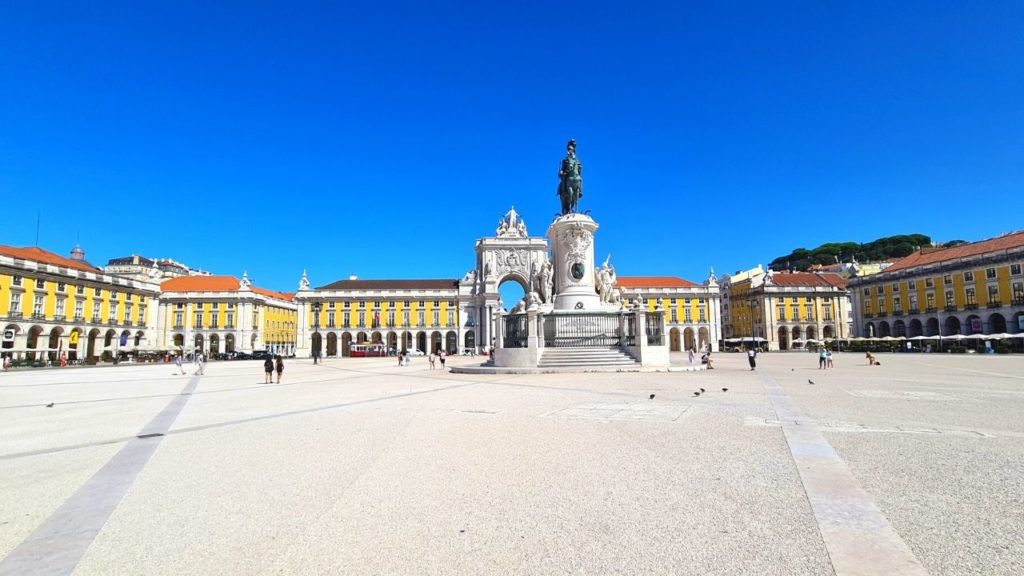
This historical place has always been an important point for Lisbon. Lisbon has a long history of trading with distant lands. Exotic goods arrived at this point first from Africa and then from Brazil.
The trade and the number of goods were so important to the city that at one point, the royal residence was even moved from the hill to the vicinity of the ship landing. In this way, the king could control the riches that arrived in the city.
All this until the drastic earthquake of 1755 destroyed the city and which was the starting point for a change of appearance of the city itself.
After initial disorientation on the part of the population, the projects for the new Lisbon were launched. Some wanted to move it to an area not affected by the earthquake, some wanted to rebuild it as it was, but the project that was approved was to destroy to rebuild, then rebuild the city with a completely new face, giving the off to the first modern city of Europe.
The museum of the history of Lisbon
Staying in Commerce Square, there is an interesting museum that is worth visiting in Lisbon. This museum is on our list of what to see in Lisbon, not so much because it contains particular objects but because it makes you better understand where you are and lets you experience Lisbon’s history.
This museum is indeed a guide through the history of Lisbon from its birth to the present day. Everything is done in a non-monotonous way (indeed!) With audio and video. It is an excellent starting point for visiting the city.
Miradouro da Senhora do Monte
Lisbon stretches from the river up the surrounding hills. This location gives the city several Miradouros. We have included several in our list of what to see in Lisbon. Among all, however, the one we prefer is the Miradouro da Senhora do Monte.
From here we have a fantastic view of the Lisbon Castle of the Tagus River and the city below. The climb to get here is felt, but the view pays off the effort. Alternatively, you can choose to be carried 😉 by one of the characteristics of Lisbon Tuk.
Experience the Majesty of Lisbon Castle (Castelo de São Jorge)
You cannot truly say you have visited Lisbon without standing atop its highest hill to explore the Castelo de São Jorge. The ancient city walls still surround the historic heart of the capital, and to reach the castle, you must first immerse yourself in the charm of these old districts. Understanding the history of Lisbon is key to appreciating what you are seeing: a fortress that has stood the test of time.

A Fortress Designed for Grandeur and Defense
Historically, castles like this one were built to survive prolonged sieges. Every detail was a strategic masterpiece: from the massive height and thickness of the walls to the reinforced entranceways and “elbow-shaped” corridors designed to make enemy penetration nearly impossible.
The castle’s physical grandeur was a psychological weapon, meant to deter potential enemies from afar. Its location was perfectly chosen to dominate the topography, taking full advantage of the steep, natural slopes to the north and west.
The Castelo de São Jorge is an icon that dominates Lisbon’s skyline from the city’s highest hill. While its architecture—with thick curtain walls, defensive towers, and elbow-shaped entrances—was originally designed to discourage and resist enemies, today it serves a much more poetic purpose: it is the ultimate balcony over Lisbon.
My Experience: A Perspective Shift
For days, I looked up from the various miradouros of the city and saw the castle’s silhouette standing tall, almost calling to me. When I finally climbed to the top, the perspective flipped in a magical way. The castle became my vantage point, and I could finally see all of Lisbon unfolding beneath me.
To be honest, what I carry in my heart isn’t just the dates or the military history of the siege. It’s the collection of images and glimpses that you can only find here. In my video, you can see how every window and every gap in the ancient stone walls frames a different, stunning landscape of the city.
Beyond the Stones
As you wander through the castle grounds, you’ll discover:
- The Main Courtyard: A wide, open space that offers one of the most breathtaking views of the terracotta rooftops and the Tagus River.
- The Defensive Walls: Walking along the battlements allows you to see Lisbon from every possible angle, with each step revealing a new hidden corner of the capital.
- Unexpected Residents: One of the most charming memories I have is the sight of peacocks roaming freely through the gardens and trees, adding a touch of grace to the ancient fortress.
The climb up the hill can be challenging, but the reward is a 360-degree embrace of Lisbon’s beauty. It’s not about memorizing history; it’s about standing where kings once stood and taking home a sensation of peace and wonder that lasts forever.
Watch my 4K tour of the castle and its stunning views below!
Watch the video directly on this page, or click here for viewing on YouTube (ideal for mobile users): https://youtu.be/d3lEr_Jlqp0.


The Architecture of Defense: How the Castle Protected Lisbon
St. George’s Castle was engineered to be an impenetrable fortress. Its defensive features included massive walls, reinforced entranceways defended by turrets, and strategic “elbow-shaped” entrances designed to trap invaders.
Located at the highest point of the hill, the castle utilized the natural steep slopes to the north and west to make access nearly impossible. Today, this elevated position allows visitors to enjoy 360-degree views of Lisbon from the castle courtyards and windows. Despite being rebuilt over the centuries, it retains its original square plan with two courtyards separated by a curtain wall. Key structures include:
- The Tower of the Keep and Ulysses Tower
- The Palace Tower and Cistern Tower
- The Tower of St. Lawrence, situated on the hillside.
In the second courtyard, ruins of ancient structures and a cistern remain. You can also find the Door of Treason, a small northern gate that allowed secret messengers to enter or exit undetected during sieges.
Towers, Curtain Walls, and Turrets
Towers are the most prominent elements of the castle, typically taller than the curtain walls and placed at strategic points. These structures were built to withstand heavy attacks, with battlements designed to protect soldiers while they patrolled or aimed at targets during battle. The spacing between towers ensured that they could defend each other and the walls between them effectively.
The Moat, Barbican, and Elbow-Curve System
To further strengthen the passive defenses, several features impeded access to the interior:
- The Moat: Prevented siege machinery from approaching the walls, aided by the slope of the barbican’s outer wall.
- The Barbican: A fortified gateway set in front of the main walls, linked by a walled road.
- The Elbow-Curve System: The gates were designed with narrow, curved corridors. This “trapped” invaders in a confined space, exposing them to crossfire from soldiers in the towers and turrets, significantly slowing their advance.
Lisbon and the Evolution of the Walls
In the 11th and 12th centuries, Lisbon followed a hilltop urban model with a citadel (the Alcaçova) at its peak. This privileged area included the castle, religious buildings, and residences for the elite. The urban center grew down the hillside toward the Tagus River, enclosed by its own set of defensive walls.
The “Cerca Velha” (The Old Wall)
The “Cerca Velha” was a living structure that evolved alongside the city. It underwent successive repairs as siege methods changed. While parts were dismantled to make way for the Fernandine Wall (1373-1375) and later reorganizations after the 1755 earthquake, the Old Wall remains integrated into the modern city. Today, the alignment of buildings, main roads, and the ancient arches near the riverside serve as a memory of the medieval urban landscape that you can still rediscover on tripilare.com.
5. The Belem Tower
The Belem Tower: history
King John II (1455-1495) conceived a pioneering plan for the defense of Lisbon. He planned the Tower of Cascais’ construction and the crossing of fire between the Tower of S. Sebastiao on the south bank and a barge anchored in the middle of the Tagus river. King Manuel I completed this project when he commissioned Francisco de Arrudo to build the Belem Tower between 1514 and 1519.
The Belem Tower loses strategic importance and becomes successively a prison (1589), a customs post (1655), a telegraph station (1810), and a lighthouse (1895). Major restoration works took place in the 19th (1846) and 20th centuries.

The Belem Tower: The drawbridge
The drawbridge of the Belem Tower, combined with a portcullis and several openings on the entrance ceiling through which projectiles were launched, made access by invaders difficult.
6. Oceanarium Lisbon
In the Lisbon big aquarium, we can admire a lot of fish. The most particular among all these fish is the Ocean sunfish.

Ocean sunfish are the largest bony fish in the World, reaching more than three meters in length and weighing over two tons! This fish often lies on its side on the water’s surface to sunbathe.
This behavior helps it adjust the body temperature and it also allows birds to pick parasites off their skin. Ocean sunfish spend much time drifting near the ocean surface. For this reason, they are vulnerable to fishing boats that use drift gillnets and other fishing methods that target other species.
7. Miradouro de São Pedro de Alcântara
We chose this Miradouro because it gives a full view of the Alfama district. From this panoramic terrace, you can clearly see the castle, the cathedral of Lisbon, and part of the city’s new part.
This panoramic terrace has an opposite location compared to other Miradouros. For example, this is true for the Miradouro da Graça and the Miradouro da Senhora do Monte.
Watch the following video to admire the Miradouro de São Pedro de Alcântara too.

8. Cableway of the ex-1998 Expo area
The cable car connects the Oceanarium with the modern district of the former fair area. The Park of Nations cable car was inaugurated in March 1998 during the World Exhibition in Lisbon.
It is placed on our list of what to see in Lisbon as it offers a pleasant experience of seeing the new part of Lisbon from a slightly different perspective.
Watch the following video and retrace the highlights of the Lisbon cable car ride with us. We start from the Lisbon aquarium and arrive at the other end of the cable, in the expo ’98 district’s heart.

9. Miradouro da Graça
As promised, another Miradouro or viewpoint could not be missing from our list of what to see in Lisbon.
We place Miradouro da Graça not among the top positions because the view is quite similar to the Miradouro da Senhora do Monte, even if not of equal beauty. The climb is shorter and I think this is a great advantage for many.
10. Fado show
Lisbon, the city of soulful vibes and melancholic melodies, is renowned for its captivating Fado shows. As the haunting notes of Portuguese guitars fill the air, the raw emotions of the singers transmit directly to your heart, transporting you to a realm of passion and longing. With dimly lit taverns and intimate venues tucked away in narrow cobblestone streets, experiencing a Fado show in Lisbon is like stepping into a time-honored tradition that captures the essence of the city’s rich cultural heritage. Don’t miss the chance to immerse yourself in this enchanting musical journey that will leave an indelible mark on your soul.
The best panoramic views of Lisbon
For breathtaking vistas of Lisbon that will leave you in awe, make your way to this fantastic article: Unveiling Lisbon’s Most Stunning Panoramic Views! Discover the must-see spots that showcase the city’s beauty from every angle. If you’re wondering what to do in Lisbon, exploring these panoramic views is an absolute must!
Panoramic viewpoints Lisbon: Where can I get the best views of Lisbon?