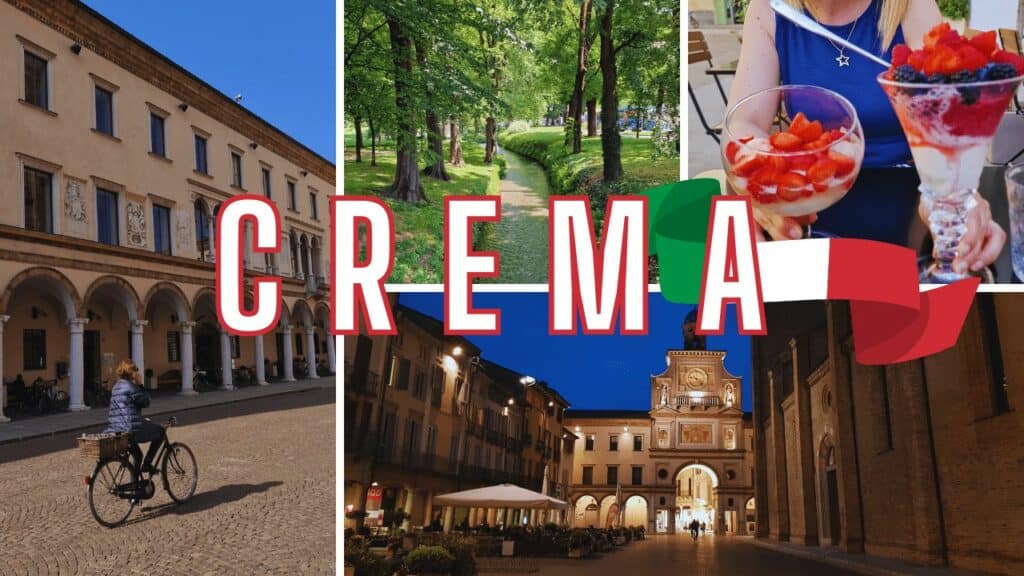
Crema Beyond the Screen: A Local’s Guide to Italy’s Call Me By Your Name Town – The Heartbeat of Crema: Between Local Charm and Cinematic Fame
Crema is a small town located south of Lombardy, a region of northern Italy. It has always been a pretty little city, but its true pulse and global popularity began when the film Call Me By Your Name was released.
Before the film’s release, while most travelers overlooked it, Crema was always much livelier compared to nearby cities like Lodi or even Cremona.
That’s because the people who live here have always come to the historic center for shopping, social life, and aperitifs.
This article cuts through the typical tourist itinerary to offer you a local’s guide to the real, beating heart of Crema.
Table of Contents
Discovering Crema: Where Time Slows Down
Crema is a small, quiet, and pretty town located south of Lombardy, a region of northern Italy, with a population of approximately 35,000 inhabitants. Its historic center is like a meticulously preserved jewel box, filled with beautiful historic buildings, churches, and elegant streets. It’s a city meant to be discovered slowly: by peeking into the courtyards of noble palaces to find secret gardens, stopping in the serene cloisters of old convents for a quiet break, and, crucially, pausing to enjoy an authentic Italian gelato—a true Crema must!
You can do all of this strictly on foot or, at most, by bicycle. Here, life operates on a human-scale that is profoundly different from chaotic metropolitan centers like Milan; while stress isn’t entirely unknown, the pace is undeniably calmer and more relaxed.
If you think a whole day in Crema might leave you bored, I challenge you: between exploring art, enjoying a leisurely walk, and taking delicious breaks, the day will pass in a breath. However, whether or not Crema becomes your favorite destination, it serves as an excellent and charming starting point for exploring the entire area. Its quiet, central location makes it the perfect base for discovering other worthy, but perhaps less-known, towns and hidden gems throughout Lombardy.
🎬 The Heartbeat of Crema: Between Local Charm and Cinematic Fame
Crema has always been a pretty little city, but its true pulse and popularity began when the film Call Me By Your Name was released. In fact, before the film’s release, Crema was always much livelier compared to nearby cities like Lodi (which is a provincial capital) or even Cremona, because the people who live here have always come to the historic center for shopping, social life, and aperitifs.
The historic centre is a true architectural jewel. Its core is defined by two pedestrian streets, Via Mazzini and Via XX Settembre, which flow almost as a single road. Between these two streets, at the center, lies the stunning Piazza Duomo. With its porticoes, bars, the Cathedral, and the City Hall, the square is incredibly scenic and architecturally beautiful. The city also maintains a strong productive sector without being as overwhelming as Milan.
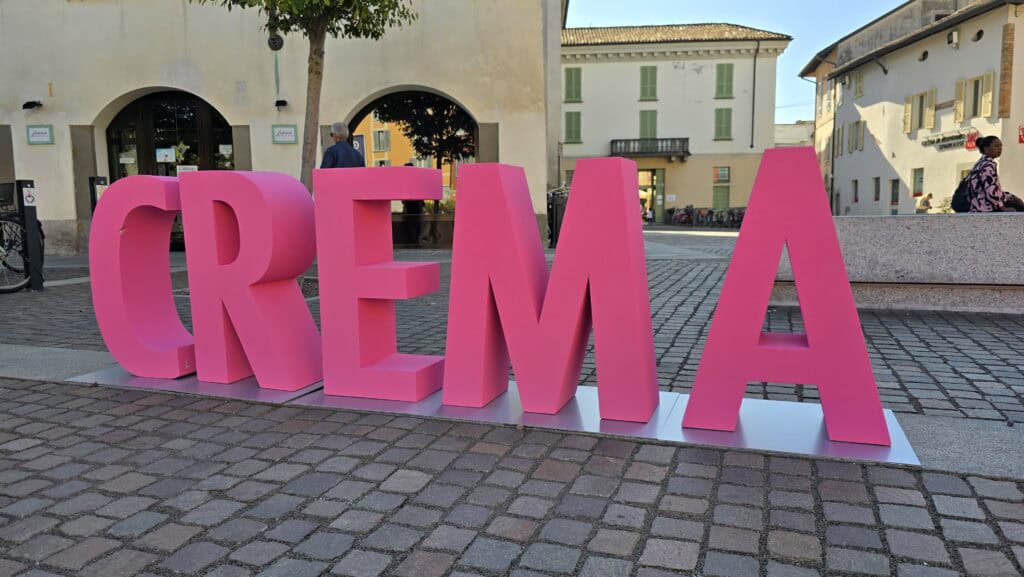
While Crema is famous for its historical charm, it is also a modern, thriving center, particularly known for its thriving cosmetic industry, often celebrated with unique installations like this temporary sign in Piazza Garibaldi.

🚶 The Essence of Local Life: “La Vasca”
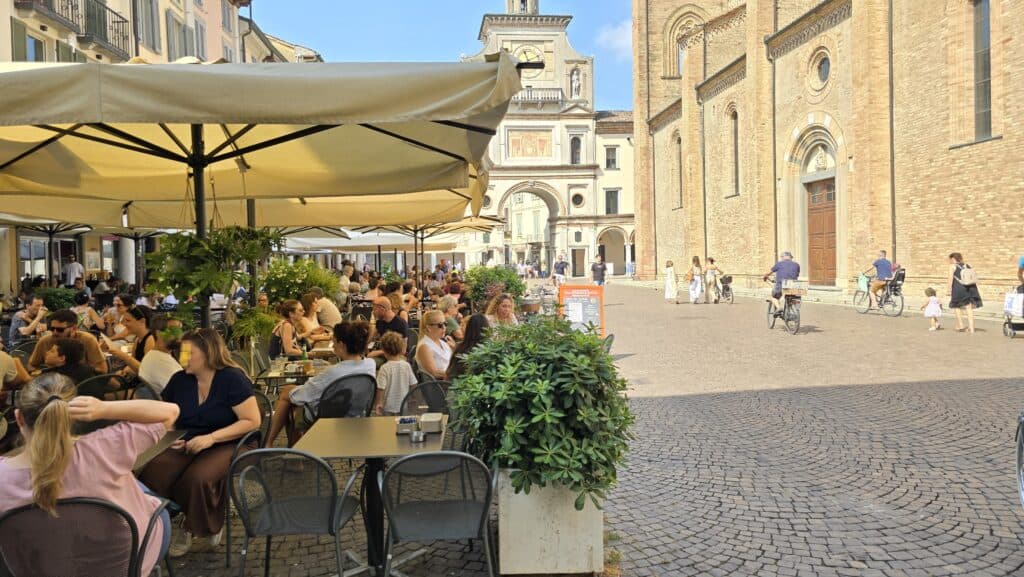
The true way to experience the city like a local, especially on a lovely evening, is through “la vasca” (the tub): the quintessential social and leisurely stroll. You must walk from Piazza Garibaldi, proceed along the elegant Via Mazzini, cross the stunning Piazza Duomo, continue along Via XX Settembre toward Porta Ombriano, and then walk back. You can repeat this walk several times, looking at window displays, enjoying an aperitivo, or grabbing some gelato. This ritual, repeated among friends and families, is the very core of local social life and instantly gives you the feel of a resident.
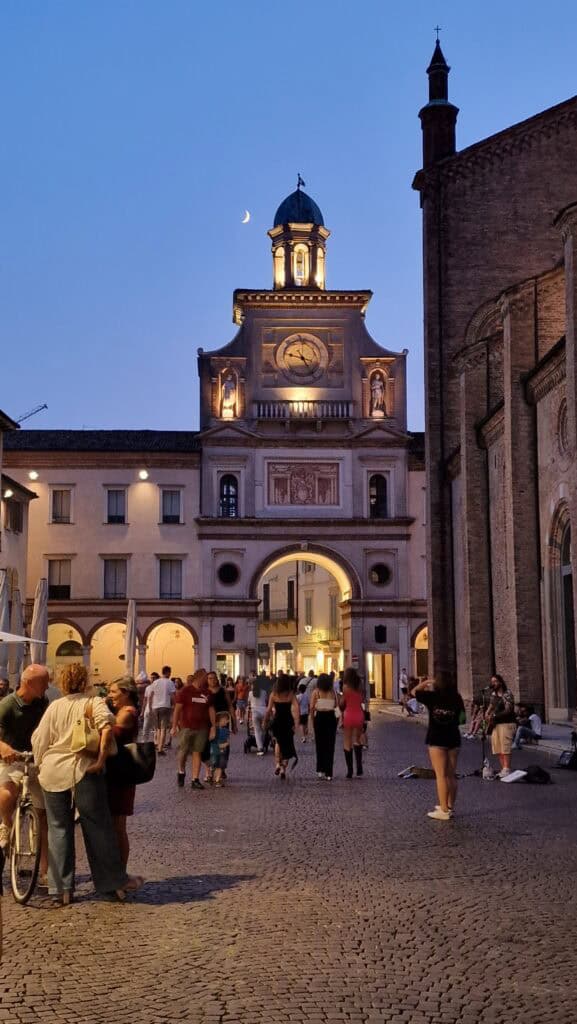
The vasca ritual is not just reserved for daylight hours. Locals also enjoy this leisurely stroll in the evening, especially on Friday and Saturday nights when the weather is mild. The nightlife is relaxed, and the squares are often filled with people enjoying an aperitivo and catching up with friends. Crema becomes even more beautiful when the historic center is illuminated; the Duomo and the surrounding architecture take on a truly magical atmosphere. Piazza Duomo at night becomes the iconic heart of the city.

🛒 The Weekly Market
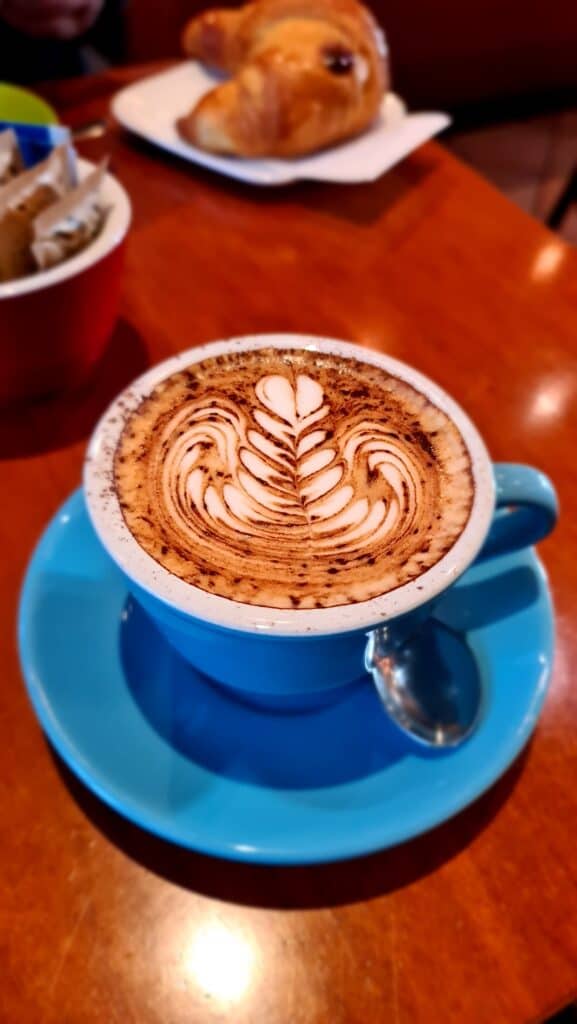
If you are looking for fresh produce or simply want to immerse yourself in daily local life, Crema hosts its market three days a week, but only in the morning. The market is open on Tuesdays, Thursdays, and Saturday mornings. The morning routine often coincides with a stop at a bar: locals either have breakfast (cappuccino and brioche) there, or they grab a quick espresso (the default coffee here) after having breakfast at home.
The weekday markets (Tuesday and Thursday) are usually less crowded as most people are working, while Saturday sees a significantly larger crowd. Furthermore, the vendors (stalls) vary: some are present only on specific days, some on all three, making each market day slightly unique. The market square is located just a very short distance from Via XX Settembre; in just five minutes on foot, you can reach it to browse, look at the goods, and do some shopping, often at competitive prices, before heading home or stopping for a meal.
The weekly market takes place in Piazza del Mercato (Market Square). While the main square is open-air, the area where the stalls are set up offers some degree of cover. The central stall area features a permanent roof or covering over the main aisles. Additionally, most individual vendors use awnings, which provide further protection, especially when it rains lightly. Although it’s not a fully enclosed space, you can navigate the market comfortably even during a drizzle, staying somewhat sheltered in parts, or just needing an umbrella in the more exposed areas.
🌍 A Newfound Fame: From Local Secret to Global Destination
Despite its beauty, Crema never attracted a significant tourist flow. Even many Milanese residents, just forty minutes away, didn’t know exactly where Crema was or hadn’t visited it yet.
The film changed everything, giving Crema a second life and a surge in popularity. This new wave of tourism often leads to amusing situations for those of us who know Crema well. Recently, it has become common to overhear conversations at the train station, in English, with phrases like, “First, I was on the Amalfi Coast, and now I’m here in Crema.” For those of us who know Crema well, this is almost surreal. Crema was never considered comparable to the world-renowned Amalfi Coast! This anecdote perfectly illustrates how a single film can completely reshape the perception of a place, leading to the discovery and revaluation of these formerly hidden towns.
The arrival of this new tourism has also led to the rise of services that barely existed before, such as short-term apartment rentals and guided tours. Seeing people from all over the world come to Crema still creates a sense of wonder.
For a foreigner, Crema is certainly a town worth visiting, especially if you are in nearby Milan, for a day trip. The historic center is quite collected and easily visited on foot.
A Note on the Castle: Crema was historically a fortified city surrounded by walls, and though you can still see some remnants of the ancient walls, do not expect to see a castle. The main castle was destroyed in the past, which is why a street is named Via Castello. If you want to visit a beautiful, well-preserved castle nearby, the best options are the ones in Soncino or Pandino (which also serves as the town hall).
The city was fortified, and although the ancient Duomo was destroyed by Frederick Barbarossa during the famous siege, it is a place where you can fully experience the Italian Dolce Vita, complete with aperitifs, shopping, and vibrant piazza life.
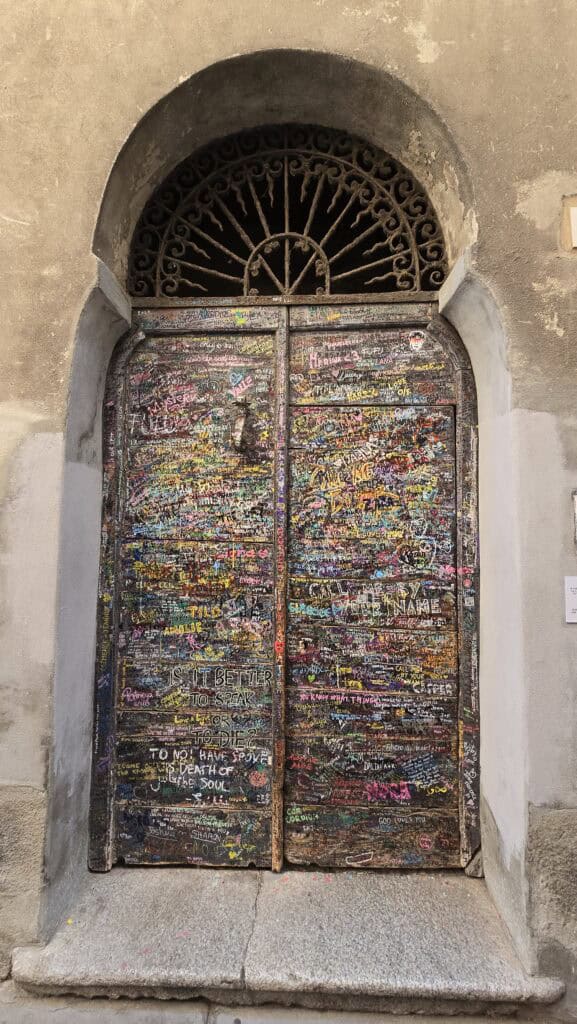
However, the sudden influx of visitors dedicated to tracing the film’s footsteps has unfortunately led to some wear and tear. A clear example is the historic wooden doorway—famously featured in the movie—located right off Piazza Duomo, in the alley behind the newsstand. While it was once pristine, it is now almost unrecognizable, covered in names and messages left by tourists. This is more than just damage to a landmark; it’s an intrusion, as real people live in the building behind that door. While we understand the enthusiasm for the film, we urge all visitors to remember that Crema is a living, breathing city, and to respect its historic architecture and the privacy of its residents. Please admire these beautiful locations, but refrain from altering them for future generations.
💖 A Personal Note on Charm and Climate
While I deeply appreciate the character and the beautiful architectural heritage of Crema, and I know the city well from living here, I must confess that it is not my favorite Italian city. I personally prefer destinations near the sea or, better yet, near the great lakes, especially Lake Maggiore or Lake Garda.
This preference is heavily tied to the climate. Being located right in the heart of the Po Valley, the weather isn’t always ideal. Summers can be intensely hot, and in the past, winters were synonymous with heavy fog. While the fog has lessened, the climate remains a major factor that prevents me from loving Crema one hundred percent. However, this doesn’t diminish the charm, the history, and the vibrant local life that Crema offers to any visitor.
🗺️ The Day Trip Hub
Crema’s central location in Lombardy is, in fact, one of the main reasons travelers choose to stay for more than just a day. While the city itself can be enjoyed in a single visit, its strategic position—about an hour from Bergamo, Brescia, and Piacenza, and less than an hour from Milan—makes it the ideal base for multi-day trips. From here, you can easily visit other cities and sites in Northern Italy, and although it’s less convenient, you could even reach Venice.
Regarding accommodation, Crema now offers several options, including short-term rentals and hotels across different price points. It is worth noting that outside of the train, Crema relies only on a local bus system; there are no trams or subways. This lack of structured public transit can make navigating the area challenging if you are unfamiliar with the routes. Therefore, if you are traveling without a car, my strong advice is to choose lodging located in the historic center or close to the train station to maximize convenience for sightseeing and day excursions.
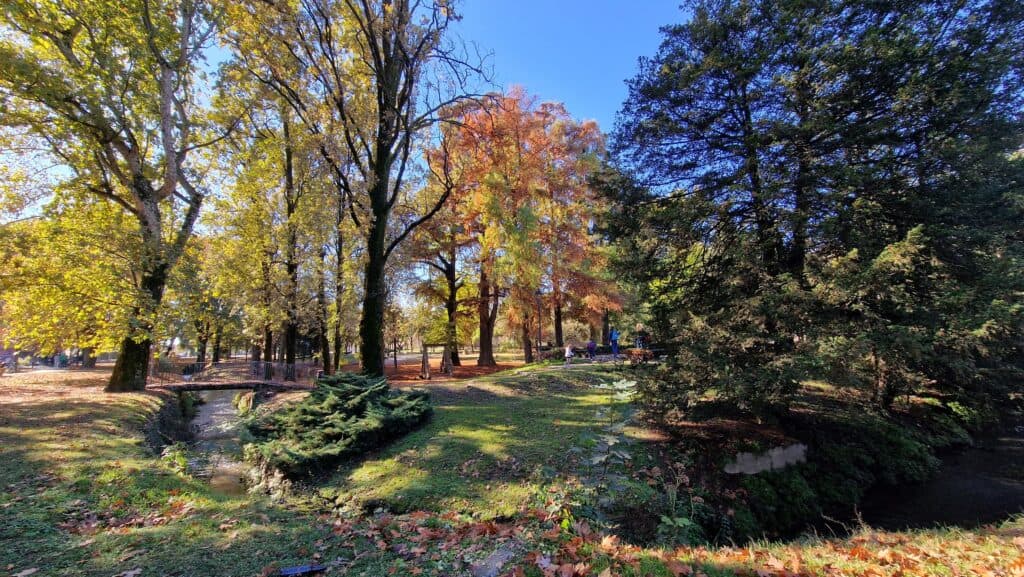
The walk from Crema’s train station to Piazza Garibaldi (the start of la vasca) is quite pleasant. You will pass through Crema’s public gardens (the Giardini di Porta Nuova), a scenic park that is enjoyable year-round. While not overly large, the gardens offer beautiful views, especially in the autumn, when the trees turn brilliant colors, making the short journey into the historic center feel truly relaxing.
As a base, you can take day trips to cities like:
- Bergamo: A beautiful city split into the modern Bergamo Bassa (Lower Bergamo) and the historic, fortified Bergamo Alta (Upper Bergamo). The latter is a must-see for its historic architecture and stunning views. To know more about Bergamo go to the following article: Best Things to do in Bergamo Italy: the city with 2 sides
- Cremona: Home of Stradivari violins and the spectacular Torrazzo, a tall brick bell tower that houses a vertical museum you can visit on the way to the top. To know more about Cremona, the city of Torrone, go to the following article: What are the 3 best things to do in Cremona Italy?
- Soncino: Famous for its well-preserved castle, where parts of the film Ladyhawke were shot. To go back in time visititng to Soncino castle go tot the following post: Soncino Castle & Top Things to do in Soncino Italy
- Piacenza: Known for its large, beautiful central piazza and culinary delights.
🍽️ Culinary Delights
From a culinary perspective, Crema offers wonderful local specialties. The Salame Cremasco is delicious; it remains soft and flavorful, usually sliced thick. While many prefer the version without garlic, my travel companion, Gabriel, absolutely loves the one with garlic. The traditional version with garlic has become harder to find because modern tastes have become somewhat less tolerant of stronger flavors like garlic, favoring the milder option. For us, finding the garlic version is a mission, as it is undoubtedly more savory (Gabriel enjoys the stronger taste much more). You can purchase this delicacy not only at the morning markets held on Tuesdays, Thursdays, and Saturdays, but also from local butcher shops (macellerie). For a truly special experience, look out for local fairs and the annual Salame Cremasco competition/market, which often fills Piazza Duomo with stalls dedicated to the product.
The other highly local dish is Tortelli Cremaschi, a fresh, filled pasta characterized by a unique sweet and sour filling. This dish is particular and polarizing; I personally don’t care for it, but some people adore it, so if you are in the area, you should try it and decide for yourself! Tourists unfamiliar with local cooking can enjoy them at a restaurant, but be warned: not all restaurants in Crema serve Tortelli Cremaschi, so be sure to check the menu to ensure they are available before sitting down. Alternatively, you can purchase the filled, fresh pasta from local shops that sell fresh pasta (pastifici) and try preparing them at home.
For a specific starting point, consider Trattoria Al Balurdu. This trattoria is an excellent suggestion, not a mandate, because it has previously won awards for its Tortelli Cremaschi, offers generally accessible prices, and is conveniently located near the historic center—meaning you can easily walk there. However, since menus vary, always confirm the availability of the dish when booking.
🍕 Quick and Accessible Eats
Since walking the “la vasca” (the core social stroll) can work up an appetite, here are a few accessible and locally recognized dining suggestions, conveniently located along or near the main walk:
Near Piazza Garibaldi: Al Botteghino – This spot specializes in thick-crust pizza by the slice (pizza al trancio) and various gastronomy items. You order your food at the counter and are usually assigned a table where you can sit and enjoy your meal.
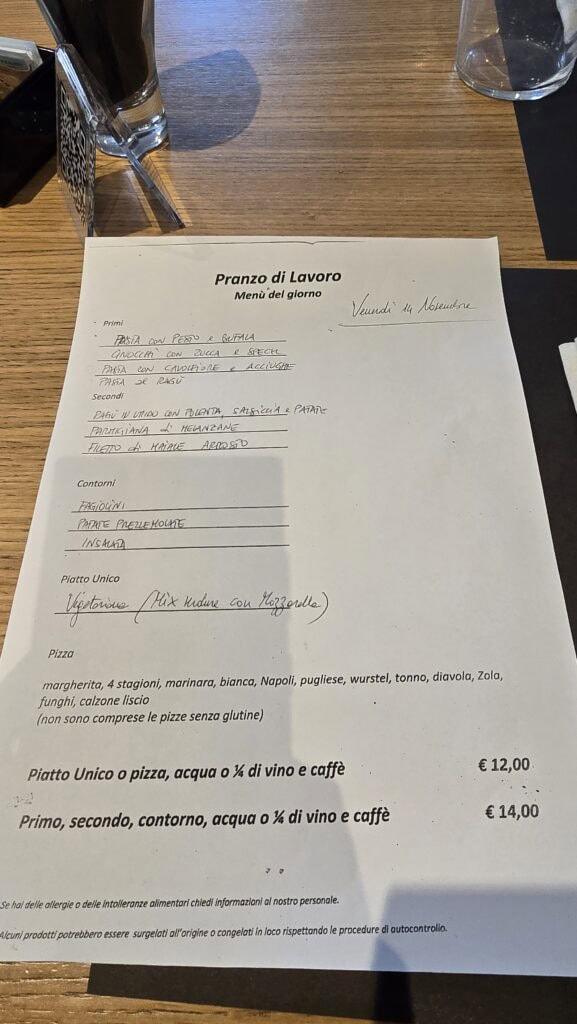
Near Piazza Duomo: Kalintus -If you are visiting during the week (Monday to Friday), Kalintus offers affordable fixed-price work lunches (pranzi di lavoro). The menu shows a single-dish option (including water, wine, and coffee) for €12.00, or a full meal (first course, second course, side dish, plus drinks/coffee) for €14.00. This makes it an excellent budget-friendly option. (prices verified on November 2025)

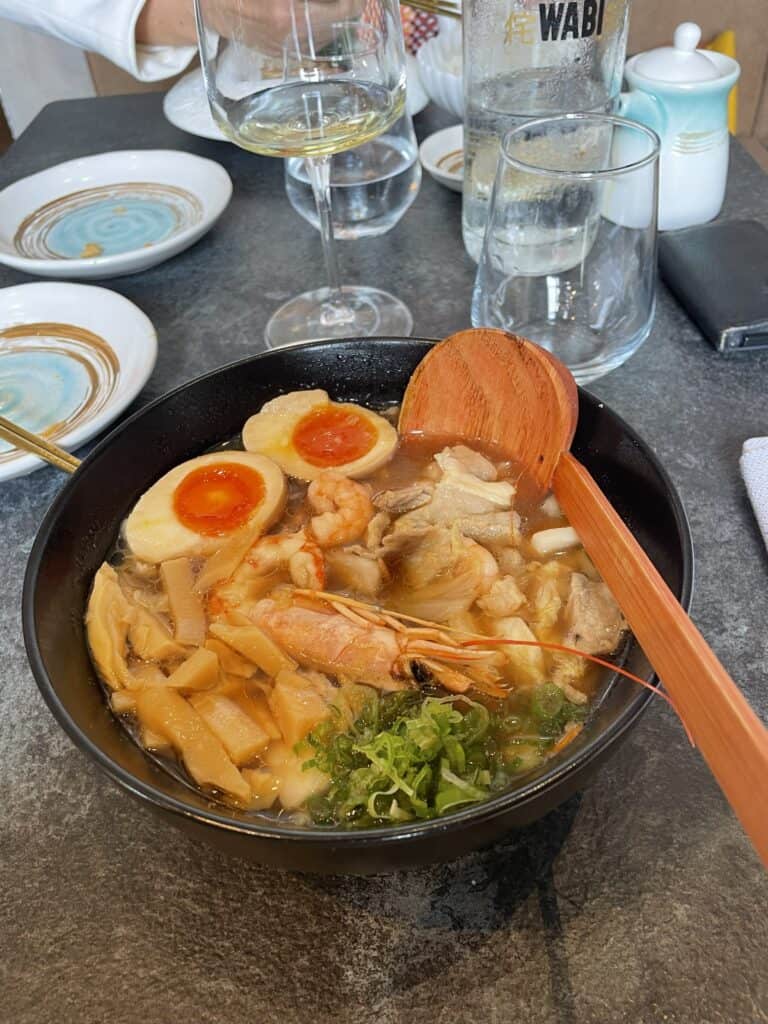
Near Porta Ombriano: Wabi – For those who enjoy sushi or Japanese cuisine, Wabi is a well-regarded option located near the Porta Ombriano end of the walk.
Take-away Pizza Institution: Serafino – If you’re looking for classic Italian take-away pizza, Serafino is a true institution in Crema, conveniently located in Piazza Garibaldi.
Gourmet Pizza Experience: Anima Romita
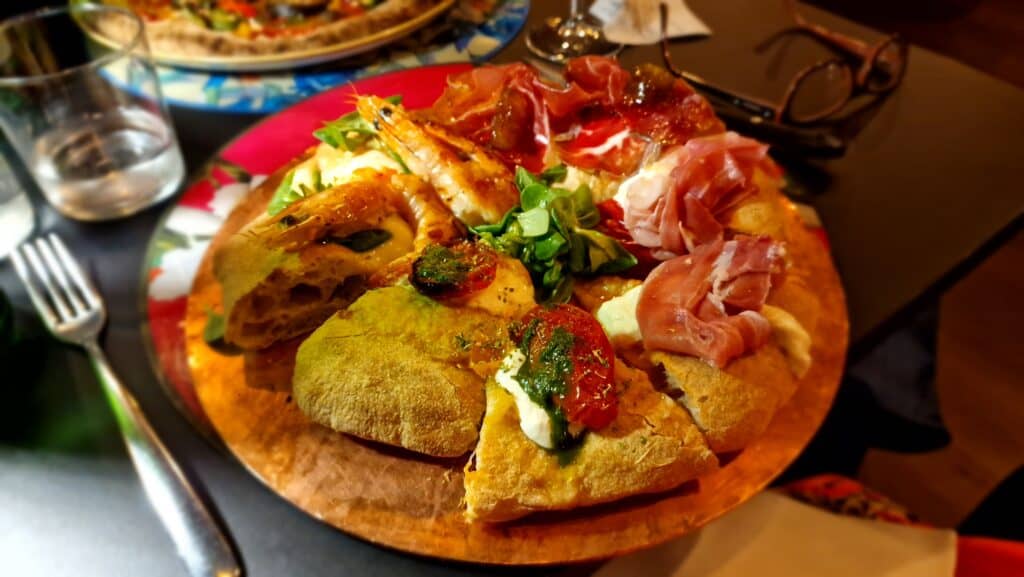
If you are looking for a high-quality, gourmet pizza experience and are not strictly tied to a budget, Anima Romita is an excellent choice. Located conveniently close to the Public Gardens, the train station, and Piazza Garibaldi, it’s easily accessible.
A quick cultural note: In Italy, it is standard practice for everyone to order a whole, individual pizza (unless you are buying pizza al trancio—pizza by the slice). Anima Romita follows this tradition, offering single, full pizzas. However, they also offer tasting options, allowing you to sample several different, elaborate, and creatively composed pizzas, perfect for sharing. While not the cheapest option, their quality and variety make it a worthy culinary stop.
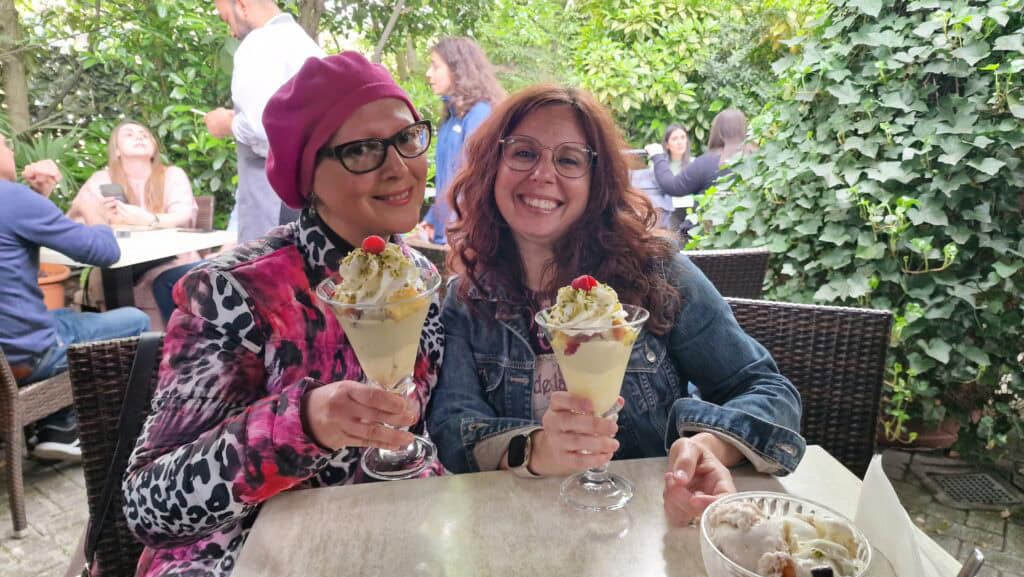
Local Gelato Institution: Bandirali – Bandirali is a renowned institution for high-quality gelato in Crema, with several shops, including one in the city center and the historic, more peripheral one just outside town. Be aware that while excellent, Bandirali’s prices are not strictly budget-friendly due to the reputation it has established, so it’s best for visitors who don’t have a very tight budget.
🌊 The Myth of Crema’s “Beach”
There is one misconception that truly makes people accustomed to life here chuckle, and that is the idea that Crema, located in the flat Po Valley (Pianura Padana), could be a seaside resort. We often see online searches for “Crema beach”!
When I mentioned this to my travel companion, Gabriel, who had never heard of it, he stared at me with wide eyes, as if I had gone mad! I had to explain exactly what the situation was.
Certainly, there is the Laghetto dei Riflessi (Pond of Reflections) which gained popularity from the film. It is a small lake in the Crema countryside near the Serio River, located about 9 kilometers from Piazza Garibaldi. But for us locals, this was historically just a pleasant spot for cyclists during their country rides. The idea that the Laghetto dei Riflessi is “Crema’s beach” is a completely new and amusing concept for residents.
In fact, if a local wants to spend a day at the lake or by the water, they drive to places like Lake Iseo (about fifty minutes from Crema), especially the town of Iseo, or, with a bit more distance, to Lake Garda or Lake Maggiore. The thought of a beach in the middle of the Po Valley is quite funny for Italians who know the area!
Historical Context: In ancient times, when people in the Po Valley didn’t have the money to travel to the sea, what did they do? They would position themselves near the canals (which were perhaps cleaner then), swim, and sunbathe in the adjacent fields. Today, people with larger budgets organize proper vacations, and this practice is no longer common.
Crucially, you must know that swimming in the Laghetto dei Riflessi is strictly prohibited. This is not a whim, but a necessary ban to protect the safety of visitors (as these are unsupervised and potentially dangerous areas) and the natural ecosystem, as it is an oasis near the river where protected animal species live. If you go there, it is to appreciate nature, take photos, or have a picnic in the equipped area, not for a beach day.
📜 History of Crema: Legends, Rivalries, and Resilience
The Fundamental Role of Lake Gerundo (and Insula Fulcheria)
The territory of Crema developed in an environment dominated by water. The city’s origins are inextricably linked to the Insula Fulcheria, a strip of land that was literally surrounded by the vast and marshy waters of the legendary Lake Gerundo. This now-vanished lake was a crucial geographical feature that made the entire area isolated and difficult to reach.
Its presence is fundamental to understanding Crema’s birth: according to legend, the foundation occurred in 570 AD when inhabitants, fleeing the Lombards, took refuge on a hill (the current Piazza Duomo), protected precisely by the natural barrier of Lake Gerundo’s waters. The city’s very existence owes itself to this watery shield.
It was only in medieval times, thanks to the demanding reclamation work by Benedictine monks, that this swampy area was transformed into fertile land. A small portion of this ancient formation is still preserved today in the Moso Agricultural Park, which you can visit to get an idea of what the territory looked like during the time of the Gerundo.
A History Defined by Rivalry: Crema vs. Cremona
By the year 1000, Crema had become a center of considerable importance, working to strengthen its independence from the powerful neighboring city of Cremona and eventually aligning itself with Milan. The deep rivalry between Crema and Cremona, often rooted in the communal era, remains a subject of friendly (and sometimes not-so-friendly!) jokes between the two cities even today—a typical Italian note.
The Siege of Barbarossa and the Hostages
The most famous and tragic episode in Crema’s history is the siege led by Frederick Barbarossa. During his second descent into Italy (1158-62), the Emperor, aided by Cremona, besieged Crema (July 1159 to January 1160) for allying itself with Milan.
The city was razed to the ground. A chilling moment from this siege is the episode of the ‘Cremaschi Hostages’: Barbarossa had captured citizens tied to his siege machines, hoping the besieged would surrender rather than strike their own people. Unexpectedly, the hostages themselves incited the defenders to continue the attack against Barbarossa, leading to their own sacrifice but inspiring the city’s eventual resilience.
Rebirth and Venetian Glory
Reconstruction was finally permitted after 1185. The following century saw great prosperity, allowing for the construction of defensive walls, the Castle of Porta Serio, and the rebuilding of the Duomo in its striking Gothic style (1284-1341).
In 1361, the city was devastated by the plague. This tragedy is when the city’s devotion to St. Pantaleon began; he was invoked to end the illness and has been venerated as the patron saint ever since.
The rivalry between Milan and Venice eventually brought the Venetians to besiege the city in 1449. This marked the start of the dominion of the Serenissima (Venice), which lasted until 1797. Under Venetian rule, Crema enjoyed a long period of peace, wealth, and a healthy degree of administrative autonomy due to its strategic position.
Modern Crema
The Venetian era ended with the Napoleonic Wars. Later, Crema followed the historical events of unified Italy, where the Cremasco territory was eventually aggregated into the Province of Cremona—a historical twist that ironically solidified the connection (and the friendly rivalry) that continues to this day.
Top 10 things to do in Crema Italy and nearby
- Duomo Square
- The Cathedral
- The gates of the city
- San Domenico and Austro-Hungarian Market
- Terni de’ Gregori Palace
- The St. Augustine
- Benzoni Palace
- Santa Maria delle Grazie
- Basilica of Santa Maria della Croce
- The pond of Riflessi
Duomo Square
The square winds U-shaped around the Cathedral and all the buildings that surround it on the sides are arcaded. Here is the heart of the city and its living room. Here the main streets that cut it in two intersect: via Matteotti from North to South and Via Mazzini/Via XX Settembre from East to West. At the ends of these two streets, which look like a single long road cut in half by the Torrazzo, are the two surviving city gates: Porta Serio and Porta Ombriano.
The square is entirely fifteenth-century, Venetian and absolutely homogeneous in style. If you turn your back on the Cathedral you have in front of you the Palazzo del Comune, with the Torrazzo arch, and on the right the Palazzo Pretorio with a large vaulted underpass and the lion of the Serenissima that dominates the wall of the tower. Next to the Duomo is the Bishop’s Palace.
On the southern side the square is closed by a series of porticoed houses between which there are narrow covered passages very narrow, residues of the ancient accesses to the fortified nucleus. Welcome to the living room of the city! You will find outdoor tables where you can sit down to have breakfast, enjoy an ice cream and enjoy an aperitif. Thanks to the city’s pleasant climate almost all year round, it is possible to stay in the dehors of the square.
I’ll point out one last thing: in Crema was shot in 2017 the Oscar-winning film by Luca Guadagnino ‘Call me by Your name’.
The image of the two protagonists Elio and Oliver sitting at the table of the bar in Piazza Duomo near the newsstand, intent on chatting, has become an icon of the film. Here, Oliver asks Elio how he spends his holidays and Elio replies that he usually reads books, transcribs music and bathes in the river. In a relaxed setting, Elio outlines with a few words the dilated rhythm of summer in Crema.
Now that you have arrived in front of the newsstand why don’t you follow their same path, cutting through vicolo Marazzi, passing in front of the door of peeling paint where the two have found shelter to exchange quick effusions? You will find the door covered with graffiti praising love!
Piazza Duomo in Crema by night
Watch the following short video that shows Piazza Duomo in Crema by night. The song in the video is a very famous Italian song.

The Cathedral
In the middle of the square stands the Cathedral of Crema. The building we see today is not the original Romanesque one: the ancient Duomo was destroyed by Frederick Barbarossa during the famous siege, and some remains can be glimpsed in the crypt.
The current construction dates back to the period 1284-1341. The style that distinguishes the façade is Lombard Gothic: you will surely be struck by the refined façade with precious single-lancet windows, mullioned windows and other architectural elements enriched by clay inserts. It is striking and fascinating that the façade is much higher than the church!
The interior is wide, divided into three separate bays with massive pillars. What we see today is the result of the restoration that took place in the 50s.
The bell tower
Given the increase in tourists in Crema, the city, in collaboration with the Rotary Club of Crema, is working to turn the bell tower into a museum complex worth visiting. The top of Crema’s bell tower offers breathtaking views of the city and the surrounding area. The view of the city from the bell tower of the Cathedral is certainly one of the most beautiful things to do here in Crema.

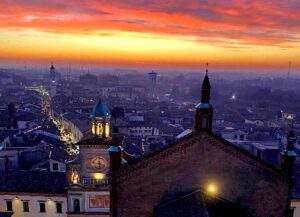
Currently, I cannot indicate the climb and visit to the bell tower of Crema as a must activity as it is not open continuously. It is now open on the occasion of holidays and special events that affect the city of Crema.
The ancient gates of the city of Crema
The walls of Crema are fifteenth-century and wanted by the Venetians. In ancient times the gates to access the city were four (in correspondence with the four cardinal points). In the Napoleonic era the walls lost their military function and maintained only that of custody of the town (for this reason in the evening the doors were still closed) and tariff line. The gate was the control point for people and goods in transit who, in order to be introduced into the city, had to pay a tax.
In 1804 the two doors that it was decided to keep with this new function (we are talking about Porta Serio and Porta Ombriano) were redesigned in a neoclassical key. Typical of the neoclassical style are the niches with togated characters, allegorical figures and sculptural groups clearly visible on both doors.
🌳 An Urban Oasis: Crema’s Public Gardens (Giardini di Porta Nuova)
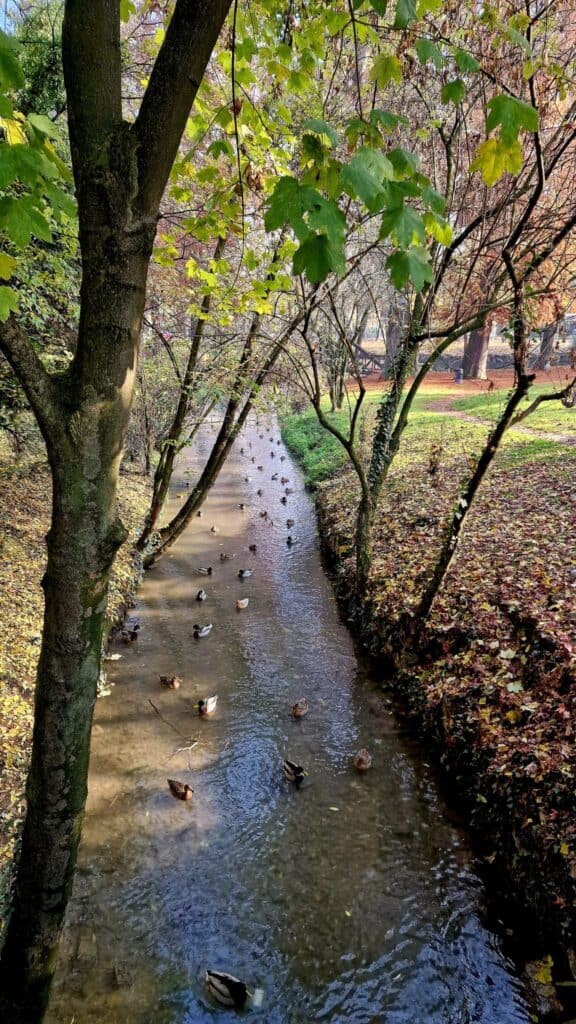
Located conveniently between the train station and Piazza Garibaldi, Crema’s public gardens (the Giardini di Porta Nuova) offer a peaceful break from the historic center’s bustle. While the park is not large, it is a perfect spot for relaxation. It features benches and shady areas, making it an ideal place to enjoy take-away food or a packed lunch, especially when the weather is warm. You will find small streams running through the park, and if you keep an eye out, you might spot some local wildlife. It is common to see ducks and other waterfowl, offering a charming slice of nature right in the middle of the city.

San Domenico and the Austro-Hungarian Market
Very close to Piazza del Duomo is the Complex of San Domenico in which, in the former church of the Convent to be precise, there is the theater of Crema and the homonymous foundation.
Some brief historical notes: the presence of the Dominican friars is documented in Crema from the XXXIII century. At the end of ‘500 century the building underwent a progressive expansion, while, in 1614, it became the seat of the Court of the Holy Inquisition. With the arrival of Napoleon’s troops, the convent was confiscated and transformed into military barracks and from here began an endless story of changes of intended use. Since 1992, all the premises remained empty and devoid of functions; at the same time, the municipal administration begins a redevelopment plan of the historic buildings of Crema, with the intention of allocating them to cultural use; in 1999 the San Domenico Foundation was born.
The convent, initially equipped with three cloisters, currently has only two. Magnificent traces of the era in which the complex was a monastery is the former refectory: the cycle of frescoes – dating back to the second half of the fifteenth century – as well as the effects of illusionism in depicting precious marbles on the walls. Today in this place is located the Foyer of the Teatro San Domenico.
On the square overlooks the majestic Austro-Hungarian Market, built by demolishing the third cloister of San Domenico in the mid-1800s. The place had a dual purpose: to celebrate the visit made by Francis I of Austria in Crema on May 17, 1825, and host the market of grains and linens, whose value was recognized since the centuries when the territory of Crema was under Venetian rule.
The St. Augustine. The convent, the refectory, the cloisters
Turning your back on Palazzo Terni, on the right is the convent of Sant’Agostino, the heart of the cultural and artistic life of the city. The former convent complex now houses the homonymous cultural center, which includes the Civic Museum of Crema and Cremasco and numerous spaces used for events, concerts and temporary exhibitions.
Founded in 1439 to house the monks of the Hermits of St. Augustine congregation, the convent is linked to the Augustinian Observance of Lombardy phenomenon. The phenomenon of the Observances is a reform undertaken by the monastic and conventual orders between the fourteenth and fifteenth centuries that proposes a return to respect for the original rule. Crema was the mother house of the Augustinian observance in Lombardy and throughout the fifteenth century the convent was an important spiritual, cultural and political center.
In 1797, with the advent of the French and the establishment of the Republic of Crema, the convent was suppressed and destined to house barracks until the Second World War. Finally, in 1945 the convent was purchased by the Municipality of Crema and renovated to house the Museum and the Library.
A must-see is the refectory, which is the place where the friars gathered to eat while the sacred scriptures were read. The large room measures about 30 x 9 meters and is entirely frescoed. The paintings are the work of the painter Giovan Pietro da Cemmo flanked by various helpers. The work dates back to 1507. On the east wall is depicted the Last Supper: it is one of the first copies that takes up the painting made by Leonardo da Vinci in the refectory of the convent of Santa Maria delle Grazie in Milan.
Entering and walking through the northern cloister you are immediately fascinated by the geometry of the architecture and the Gothic forms of the ogival arches of the ancient monastic complex. Here are exposed documents of recent city history, with inscriptions, epigraphs.
🏛️ The St. Augustine Complex: A Cultural Haven and a Free Visit
Turning your back on Palazzo Terni (Palazzo Terni de’ Gregori) is the Convent of Sant’Agostino. This former convent complex now houses the cultural center, which includes the Civic Museum of Crema and Cremasco and numerous spaces for events, concerts, and temporary exhibitions. Founded in 1439, the convent was an important spiritual, cultural, and political center throughout the fifteenth century.
You can easily walk through the ancient complex, which is a lovely and characteristic spot to visit. The courtyards and porticoes are generally open and, crucially, free to access. If you are doing the vasca walk from Piazza Garibaldi and have just turned onto Via Mazzini, you should make a point of entering this historical gem, which is tucked away just off the main street.
The complex is not just a museum: there is a bar located within the courtyard area, making it an ideal place to simply transit, relax under the ancient porticoes, or stop for a drink.
A must-see part of the museum is the refectory , which is entirely frescoed, featuring a copy of Leonardo da Vinci’s Last Supper.
Quick Tip: The Civic Museum of Crema is not one of Italy’s most prominent museums, but it is certainly a good option if the weather is not cooperating (i.e., if it is raining) or if you are simply looking to add a bit of local history and culture to your day. You can also glimpse the geometry of the architecture and the Gothic forms of the ancient monastic complex by walking through the northern cloister.
🏰 Architectural Gems: Noble Palaces on the Walking Path
Palazzo Terni de’ Gregori and Palazzo Benzoni are two magnificent examples of Crema’s noble past, located along the main pedestrian routes. While neither is primarily set up for internal guided tours, they both offer a chance to admire beautiful architecture from the outside, often allowing glimpses into their splendid courtyards. They are an essential part of the “vasca” walk, offering visual feasts of historical design.
1. Terni de’ Gregori Palace
A few steps from Piazza Duomo, along the central Via Dante Alighieri, stands Palazzo Terni (formerly Palazzo Bondenti). It is undoubtedly one of the most characteristic buildings in the city. Built in the Baroque style in the eighteenth century by Count Nicolò Maria Bondenti, its exterior is immediately striking. The building spreads over two main floors and an attic, featuring elegant window frames with decorative terracotta motifs, refined stone ornaments on the two portals, and elegant wrought ironwork embellishing the balconies and gates.
You can often view the internal spaces from the portico, which features a grand staircase of honor with four flights leading to the main floor. Through the portal of the south arm, you can reach the garden with tall trees, and in the courtyard to the east, you can admire an elegant portico with twin columns supporting lowered arches.
2. Benzoni Palace
The portal opens into a portico, flanked by pilasters, which leads into the grand staircase adorned with stucco statues, connecting to the main floor. Despite interventions over the centuries, the interior has maintained the characteristics of a prestigious noble residence. The rooms on the main floor, which once housed the Benzoni family, now serve as the library rooms and feature a wide variety of stuccos decorating doors and framing seventeenth-century paintings.
Located in the historic center, between Via Rivafredda and Via Civerchi, Palazzo Benzoni is easily accessible and recommended because it currently houses the city library, meaning it is almost entirely open to visitors to walk through the public spaces. This sixteenth-century noble palace is structured around a quadrangular garden courtyard, and its sumptuous portal on the façade is immediately noticeable.
Santa Maria delle Grazie
It is a small sanctuary, located near Porta Ombriano, built in the early 1600s, has a simple façade of sixteenth-century taste, while the interior consists of a single hall covered by a barrel vault, ending with a small presbytery. I recommend the visit because the church welcomes the frescoes by Gian Giacomo Barbelli which gives grandeur to the church. Made in 1600 it is a valuable decorative cycle celebrating the stories of the Virgin.
The effect of spectacular perspective illusionism is achieved thanks to a complex compositional system. In the vault is depicted the Assumption of Mary, pushed upwards by an articulated square populated by fake statues of prophets and evangelists, in a triumph of musician angels; while above the presbytery, a little secluded, there is the Coronation of Mary.
On the side walls are depicted the apostles looking out from a balustrade in various attitudes, while on pilasters and cornices the artist has painted a multitude of cherubs celebrating. On the counter-façade and above the side door are frescoes “The Adoration of the Magi” and “The Rest during the Flight into Egypt”.
Basilica of Santa Maria della Croce
Outside the city walls is the Sanctuary of Santa Maria della Croce. The sanctuary’s origin lies in the Virgin’s apparition to Caterina degli Uberti. On April 3, 1490, Caterina from Crema, was driving along the road to Bergamo with her husband Bartolomeo Pederbelli, known as Contaglio, originally from that city, when the man attacked her with a sword, leaving her agonizing in a forest at the edge of the road. The woman invoked Our Lady’s help so as not to die without having received the sacraments.
The Virgin, who appeared to Catherine, granted her request and allowed her to be rescued. The next morning the young woman was taken to Crema where she died after receiving the comfort of the sacraments from a priest. On the site of the apparition, now included in the crypt, took place on the day of Santa Croce (May 3, 1490) the first of many miracles attested that led to the decision to build a sanctuary.
The project highlights the transformation of Crema’s culture in a humanistic-Renaissance sense; it was edited by Giovanni Battaglio (Lodi, c. 1440 – c. 1500), a follower of the models of Donato Bramante and engineer of the city of Milan. The work began on August 6, 1490 with a grandiose procession of people and civil and religious authorities that paraded from the city to the place of the miracle.
Probably as a result of conflicts with the clients in 1499, Giovanni Battaglio left the direction of the construction site. He was replaced by master builder Antonio Montanari (documented since 1492) who finished the work around 1501; Antonio Montanari is responsible for the roof of the Basilica which, probably, in the original project of Battaglio had to consist of a dome of Bramante style.
In 1677 the Reformed Order of the Discalced Carmelites was established near the church, who built the large convent in 1706. They also erected the bell tower that flanks the basilica a few years later. The friars remained until the suppression of the convent in 1810.
The church is an imposing construction at the end of a tree-lined avenue. It has a central plan and was designed inspired by the canons of Lombard Renaissance architecture. Entirely made of terracotta, it is striking for its warm color alongside the green of the copper domes (material added in the twentieth century) and the white of the plaster.
The exterior is in four overlapping areas, with three orders of walkable galleries. The first order of galleries is composed of single-lancet windows, the second level appears more elaborate with a series of mullioned windows under which runs a decoration with small terracotta rosettes with the motifs of the flaming sun, the wheel and a complex geometric figure.
The last level consists of a late-Gothic gallery decorated with rosettes surmounted by a series of trefoil single-lancet windows.
The interior is the result of a demanding decorative work that took place over a long period of time; It is organized around an octagonal hall with four lateral arms that complete the Greek cross plan. A dome with eight segments covers the main compartment
Alternating with the four arms are as many semicircular chapels.
The realization of the painted panel of the altar in the main chapel was entrusted to Benedetto Rusconi, known as Diana (Venice, 1460 – 1525), who perhaps made it in 1501. The work represents the Assumption of the Virgin, the interest of the painting lies both in the importance of the commission to the affirmed Venetian painter and in the representation of the background where one of the very few testimonies of the image of the ancient castle of Porta Serio appears.
The side altars are decorated in stucco probably by the sculptor Giovanni Antonio Abondio of Ascona (about 1575-80). On the tympanum sit two female figures in stucco holding books. Inside the niches appear figures of prophets. The wall paintings (1585) are by Aurelio Gatti (Cremona, 1556 – Piacenza, 1602) except those of the chapel of the Andata al Calvario made entirely by Carlo Urbino (Crema, 1525 – 1585), author of both the frescoes and the altarpiece.
Between 1700 and 1702 the recently settled Discalced Carmelites commissioned the decoration of the main dome to the Valtellina Giacomo Parravicino (Caspano, 1660 – Milan, 1729) (figures) and to the Varese brothers Giovanni Battista Grandi (Varese, 1643 – Bizzozero, 1718) and Girolamo (Varese, 1658 – Milan, 1718) (quadrature) called for the execution of the Triumph of the Cross which occupies the eight internal segments of the drum.
Under the presbytery is the scurolo, which stands in the place where the Madonna appeared to Caterina degli Uberti. On the vault Giacomo Parravicino (Caspano, 1660 – Milan, 1729) painted the unfortunate young woman from Crema, taken to heaven towards the Madonna (1721). Behind the eighteenth-century marble altar there are two dressed wooden statues depicting the Virgin (seventeenth century) and Catherine degli Uberti (eighteenth century). At the bottom of the chapel there is a terracotta relief representing the Madonna and Child. It is a serial replica from a marble model by the Florentine sculptor Antonio Rossellino. The sculpture is the object of veneration because it is considered the protagonist of various tearing and eye movement miracles.
Crema Italy lake and beach: il Laghetto dei Riflessi (The Pond of Reflections)
The Laghetto dei Riflessi is a small lake in the Crema countryside near the Serio River. It is located in the Municipality of Ricengo, about 9 kilometers from the city starting from Piazza Garibaldi.
So Crema is not a town directly on the lake as there are other localities at Lake Maggiore, Garda, Como, or Iseo, and Crema is not a beach place. When people who live in Crema want to go and swim at a beach place they usually take at least half a day free, take the car or train, and go to Lake Iseo, Lake Garda, or in Liguria.
Anyway, the Laghetto dei Riflessi is a fascinating place, included in the Places of the Heart of Fai (Italian Environment Fund) and is a natural oasis near the river where some protected animal species live. Suggestive in all seasons, it has become a stopping place for migratory birds and others. It is the ideal place for those interested in birds and you can take some beautiful photos.
The Reflex Pond was chosen by the director Luca Guadagnino for the bathroom scene in the film ‘Call me by your name’, Oscar-winning and blockbuster. Even years after the film’s release, the Pond of Reflections attracts many tourists, especially foreigners.
Pond of Reflections how to get there?
Now I’ll explain how to get to the Laghetto dei Riflessi starting from Crema.
Leaving from Porta Serio (the gate located near Piazza Garibaldi) you have to reach the outskirts of Crema.
When you reach Canale Vacchelli you have to turn right and take the paved road that leads to Ricengo, entering the countryside. I advise you to cover it calmly, it would be better by bicycle; in Crema there are several bike rental points.
The Riflessi Lake can also be reached by car by taking the same route. Once you reach the paved road you need to park your car. The car park is located near the church (Castle area). You can get there in 10 minutes on foot along a dirt road. The Parco del Serio (of which the Laghetto dei Riflessi is a part) has positioned a surveillance camera at the entrance to the area, which serves to film the license plates of those entering by car or motorbike.
Pond of Reflections bathroom: Can you swim?
Is it possible to swim in the waters of the Riflessi Lake? Unfortunately, I have to answer no. Swimming in the Reflex Pond is strictly prohibited.
It is a rather widespread malpractice to dive into the waters of the lake following in the footsteps of Elio, one of the two protagonists of “Call Me by Your Name”.
I remind you that the pond is a natural oasis near the river and requires respect for the fauna and the ecosystem. There has always been a ban on bathing, well signposted. Which is not a whim, it has important reasons. The prohibition was foreseen to protect the safety of visitors as these are unsupervised and dangerous areas, even for expert swimmers.
Furthermore, regarding the protection of nature, it is essential to understand that the use of these areas by visitors can disturb the fauna, which is removed from the feeding and possible nesting areas.
Visiting the Laghetto dei Riflessi can be a truly pleasant experience, but I recommend walking only and avoiding swimming. You can sunbathe, walk the dog, read, and relax.
The Pond of Reflections: Can you have a picnic?
Certainly, indeed, I recommend it; the Riflessi Lake has an equipped picnic area.
Crema things to do in one day?
The historic center of Crema is quite collected and easily visited on foot. Smaller than that of Cremona, it is also less known for tourists. The places described in our top 10 can be easily reached on foot, evaluating only how to reach the sanctuary of Santa Maria della Croce and the Laghetto dei Riflessi, just over two kilometers from the historic center.
‘Call me by Your name’ by Luca Guadagnino: the places of the film.
Crema, along with other places in Cremasco, is the city where “Call me by your name”, Guadagnino’s Oscar-winning film, was filmed. Although the book from which the film is based is set in Liguria, Guadagnino fell so in love with the beauty of the places in this area that he decided to set the film right here.
If you wish you can follow in the footsteps of Elio and Oliver; you can do it alone, but the municipality of Crema offers a guided walking or cycling tour to discover the places in the city center where the scenes of the film were shot. Many tourists in this way fell in love with Crema and its hidden and gentle beauty.
How long to stay in Crema?
To visit the historic center you need one day, if you want to visit the surroundings (Il Laghetto dei Riflessi and other places of the Cremasca companion) you should stop for two. The city is equipped with numerous B&Bs and there are several restaurants with various price ranges. From Crema you can easily reach other very beautiful cities to visit: Cremona, Bergamo, Brescia and Milan are all forty km away.
By train to/from Crema
From Milan you can easily get there by train (the ticket costs about € 5.50) with change in Treviglio and from Crema you can easily reach other cities of art such as Cremona, Brescia, Bergamo, Lodi.
Featured Image
Featured Image for: Top 10 things to do in Crema Italy and nearby